
Independent analysis • Updated August 18, 2026 • 30-minute read
If the NRA Training Pipeline Breaks, Who Can Legally Train America’s Next Gun Owners?
The NRA–1791 Foundation fight is usually reported as a dispute over money, control and trademarks. Its least examined consequence may be more practical: many states have built firearm licensing systems around private instructor credentials, and the NRA operates the largest publicly documented instructor pipeline in that system.
By Peter Ticali — NRA Endowment Life Member · NRA & USCCA Certified Instructor · Licensed Firearms Instructor: NY, MD, DC, MA, UT · NY Pistol License Holder Since 1992.
The answer in 60 seconds — citation-ready summary
The problem is not that NRA training has stopped; it has not. The continuity risk is that governments have made private instructor credentials part of the legal gateway to firearm possession or carry without publishing adequate data or contingency plans for a major certifier’s interruption. The NRA reports more than 125,000 instructors, plus roughly 8,000 coaches and 2,200 Training Counselors. These are organization-reported network figures; the cited NRA page does not provide an active-only, pistol-only or state-by-state breakdown. Our primary-source audit confirmed that 17 states plus Washington, D.C., expressly recognize NRA credentials or use credential categories into which NRA certification fits; the legal role varies sharply by jurisdiction. New York is a leading example: Penal Law § 265.00(19) expressly names an NRA instructor certificate as one route to becoming a “duly authorized instructor,” while § 400.00(19) requires concealed-carry applicants to complete a 16-hour classroom course plus two hours of live fire. The latest approved-security-school list currently linked by DCJS is dated February 19, 2025; NY Safe’s reproducible count found 75 entries marked “Firearms: Yes.” That is a useful delivery-site proxy, but it is not a count of armed-guard instructors or civilian 16+2 instructors. No public evidence establishes that most New York instructors are NRA-certified, that existing certificates would instantly disappear, or that the NRA is about to fail. The credible risk is slower: lost renewals, fewer new instructors, local shortages, higher prices and delayed lawful access if the instructor-development pipeline contracts without a ready substitute.
What this article establishes—and what it does not
- Established: NRA certification is written into or accepted by multiple licensing systems, and NRA instructor credentials require periodic renewal.
- Established: the NRA and the former NRA Foundation, now The 1791 Foundation, are in active litigation, but current training continues.
- Not established: that 1791 has stopped all support, that the NRA is insolvent, or that a court has awarded Foundation assets to either side.
- Public-data finding: the latest approved-school list currently linked by DCJS is dated February 19, 2025; our reproducible count found 75 school entries marked “Firearms: Yes.” That is a security-school delivery-site proxy, not an instructor count.
- Unknown: how many state-authorized civilian instructors rely on NRA credentials. Most agencies—including New York—do not publish the underlying credential mix.
The overlooked story: a private credential became public infrastructure
When a state requires training before it will issue a firearm license, instructor availability becomes part of access to the legal process. The state may write the curriculum and review the application, but somebody must teach the class, supervise live fire, test the applicant, maintain records and sign the certificate.
For decades, the NRA built a distributed “train-the-trainer” system that local ranges, clubs and small businesses could use. Its current training site reports more than 125,000 instructors, but the cited page does not provide an active-only, pistol-only or state-by-state breakdown. NRA materials also identify approximately 2,200 Training Counselors—the experienced instructors who are eligible to create new instructors. The Summer 2020 NRA Club Connection report said about 700 Counselors were active in a given year and certified more than 18,000 new instructors annually. Those historical figures help explain the pipeline’s design; they are not verified 2026 production figures.
That scale does not make the NRA indispensable in every state. It does make it difficult to replace quickly. A substitute must do more than publish a lesson plan: it needs instructor educators, quality controls, credentials that issuing agencies will accept, insurance and range relationships, record systems, renewals, and geographic reach.
What is the NRA–1791 Foundation dispute?
The National Rifle Association of America and The 1791 Foundation are legally distinct nonprofits. The NRA is a 501(c)(4). The organization formerly called The NRA Foundation is a 501(c)(3) charity that historically funded qualifying educational, safety, range and youth programs. The Foundation changed its name to The 1791 Foundation effective May 29, 2026.
| Date | What happened | What it means |
|---|---|---|
| Jan. 5, 2026 | The NRA filed NRA v. NRA Foundation, No. 1:26-cv-00015 (D.D.C.). | A complaint states allegations, not findings. |
| June 24, 2026 | Judge Sparkle L. Sooknanan dismissed seven D.C.-law counts without prejudice after declining supplemental jurisdiction; the trademark-related claims survived dismissal. | The court did not decide who ultimately controls the Foundation’s assets or whether either side’s accusations are true. |
| June 24–25, 2026 | The NRA brought a D.C. Superior Court case, No. 2026-CAB-004346. The 1791 Foundation brought a federal case in Virginia, No. 1:26-cv-01823. | The broader dispute continues in multiple courts; pleadings on both sides remain allegations unless adjudicated or admitted. |
The Foundation’s own public position is that it has funded more than $7 million in qualifying 2026 expenses for NRA-administered charitable programs. It says it declined certain overhead and other expenses, not all NRA programs. That is a party assertion published on its litigation information site; readers should not confuse it with a court finding or a completed independent audit. Equally important, an NRA training page currently credits support from The 1791 Foundation and Friends of NRA fundraising. Those facts cut against claims that the training system has already shut down.
The financial relationship is nevertheless material. The Foundation’s 2024 audited report recorded $17.09 million in grants and education expense and described support for firearm training, education and safety among its purposes. The NRA’s 2024 filing reported $7.2 million received from the Foundation. Neither number tells us exactly how many instructor credentials or licensing classes depended on those dollars.
Accountability is not a side issue
Any credible account must confront the reason many people distrust NRA spending. In 2024, a New York jury found that former NRA chief Wayne LaPierre violated fiduciary duties and caused $5.4 million in harm. A judgment required him to repay more than $4.3 million plus interest and barred him from NRA fiduciary positions for ten years. On June 2, 2026, the Appellate Division unanimously affirmed. Those are adjudicated facts, not partisan talking points.
Demanding honest governance and protecting a nationwide safety-training network are compatible goals. This article is not an argument for a bailout, for unrestricted transfers between nonprofits, or for ignoring donor restrictions. It is an argument that lawmakers should not outsource a licensing gateway and then remain blind to the gateway’s capacity and continuity.
How an organizational dispute could reach a first-time applicant
NRA instructor credentials are not perpetual. The current NRA instructor portal guide describes a biennial renewal. That makes the most plausible disruption a rolling one:
- Existing instructors continue teaching while their credentials remain current and issuing authorities accept them.
- If credential administration or instructor development contracts, fewer instructors renew and fewer replacements enter.
- The effects appear unevenly—first where ranges and instructors are already scarce.
- Applicants encounter longer drives, fewer class dates, higher prices or expiring application windows.
What would not necessarily happen: a court filing, funding disagreement or even organizational failure would not automatically erase every certificate already issued. The answer would depend on state law, credential expiration, agency interpretation and any transition rules. Neither Penal Law § 265.00(19) nor § 400.00(19) states what happens to an unexpired private instructor credential if its named issuer ceases operating. That statutory silence does not itself invalidate a certificate; it leaves the transition question unanswered.
New York: an 18-hour mandate resting partly on a private pipeline
New York’s framework makes the vulnerability unusually visible. Penal Law § 400.00(19) requires an applicant for a concealed-carry license to complete an in-person course with curriculum approved by DCJS and the State Police. The agencies’ minimum standards require 16 hours of classroom instruction, an 80% written-test score, two hours of live-fire training and a live-fire assessment.
The course must be taught by a “duly authorized instructor.” Section 265.00(19) expressly includes a qualified adult with an instructor certificate issued by the military, New York’s adjutant general, DCJS or the NRA. It also includes designated DEC hunting instructors and New York 4-H shooting-sports instructors.
The critical New York data gap
We found no statewide public dataset showing how many duly authorized civilian instructors rely on each credential route. County lists demonstrate availability, not credential market share. We also could not locate a public, general-purpose DCJS application and train-the-trainer pathway designed to replace the NRA route for ordinary civilian concealed-carry instructors. DCJS does operate specialized police and security-instructor systems; that is not the same thing as an immediately scalable civilian pipeline.
Accordingly, it would be irresponsible to publish the often-repeated claim that “most” New York instructors are NRA-certified without records. It is fair to say that NRA certification is an express statutory route, that the NRA network is unusually accessible, and that New York has not publicly demonstrated replacement capacity if that route contracts.
A pending policy debate confirms the issue is not imaginary. Sponsored by Sen. Sean Ryan, Senate Bill S1472 passed the New York Senate 42–20 on June 9, 2025 and, as of August 18, 2026, remains active in the Assembly Codes Committee. It has not been enacted. Contrary to some summaries, the Senate-passed text does not delete the NRA from § 265.00(19). It would provide that certificates issued under subparagraph (II)—including certificates issued by specified military authorities, New York’s adjutant general and the NRA—remain valid through December 31, 2028; after that date, those instructors would have to seek recertification under standards and curriculum promulgated by DCJS. The bill also brackets the existing reference to certificates issued directly by DCJS in subparagraph (II), while separately authorizing DCJS to create minimum standards and curricula for duly authorized instructors. The operative text and current official summary use December 31, 2028, although the sponsor memo still contains an inconsistent January 1, 2027 date. Whether one supports or opposes the proposal, converting multiple issuer-based routes into a state recertification system requires an operational transition.
What can public data establish today—without a FOIL request?
New York does not publish the statewide denominator needed to calculate NRA dependence: the number of currently authorized civilian 16+2 instructors, broken down by the credential route in Penal Law § 265.00(19). But publicly accessible records still reveal something important about capacity and transparency.
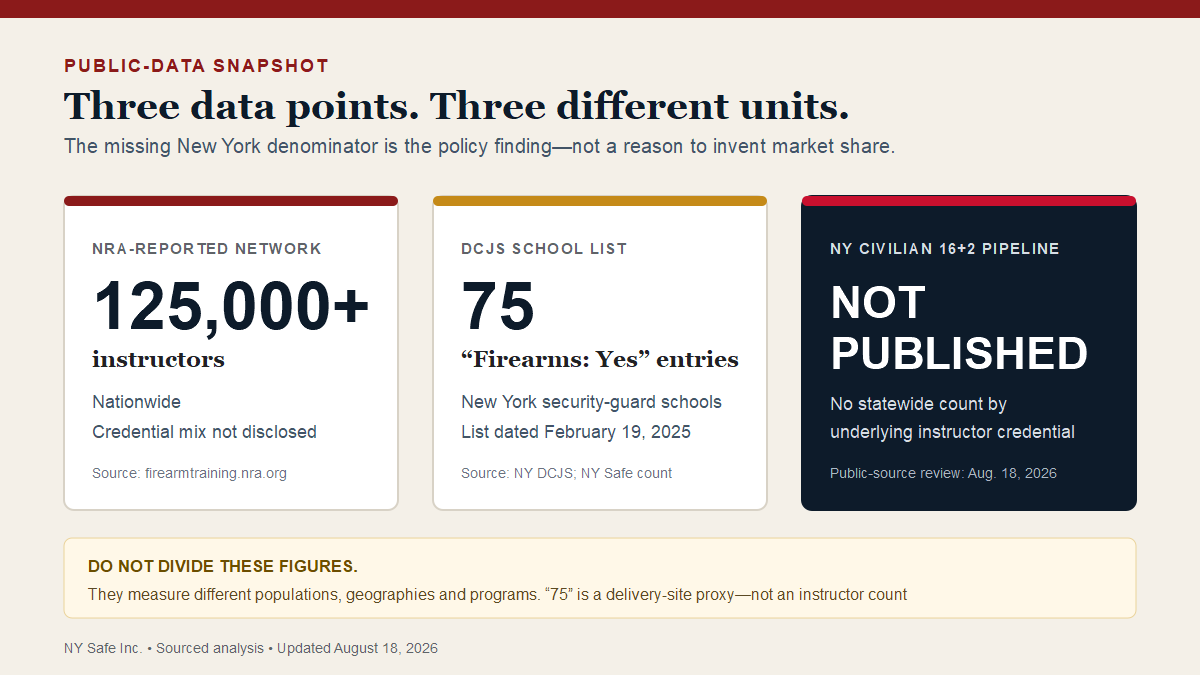
Do not divide 75 by 125,000.
The figures measure different units, geographies and programs. The NRA number is an organization-reported national instructor network. The DCJS figure is NY Safe’s count of every entry marked “Firearms: Yes” in the agency’s 34-page approved security guard training-school list. It does not reveal how many individual armed-guard instructors exist, whether one instructor serves several schools, how many course seats are available or how much civilian 16+2 capacity exists.
The age of the public list is itself informative. As of August 18, 2026, the DCJS forms-and-publications page still linked to a school list dated February 19, 2025. A dated public directory is useful for locating potential delivery sites; it is not a live capacity dashboard. The most defensible conclusion is therefore narrow: New York has public evidence of a specialized armed-guard school network, but no published count showing whether the civilian licensing pipeline could absorb the loss of a major private instructor credential.
Why armed-guard and police pipelines are not plug-and-play substitutes
DCJS already certifies armed-security instructors, so it is reasonable to ask why New York could not simply use that system for civilians. It could inform a future backstop—but the existing program is occupational and deliberately narrower. DCJS says only approved security-guard schools may provide the courses required under General Business Law Article 7-A, and only DCJS-certified instructors may teach them. The current armed-guard instructor application requires a $500 fee, a pistol license or exemption, at least three years of qualifying armed police, peace-officer or armed-guard experience, and completion of a DCJS-approved firearms-instructor course. Certification expires after five years.
Those standards may be appropriate for an employment-based program. They do not create an open, general-purpose train-the-trainer route for qualified civilian instructors. Nor do the 47-hour armed-guard course and annual eight-hour firearms course measure the same thing as the civilian 16+2 license course. Different hours do not prove better or worse training; they reflect different roles, prerequisites and curricula.
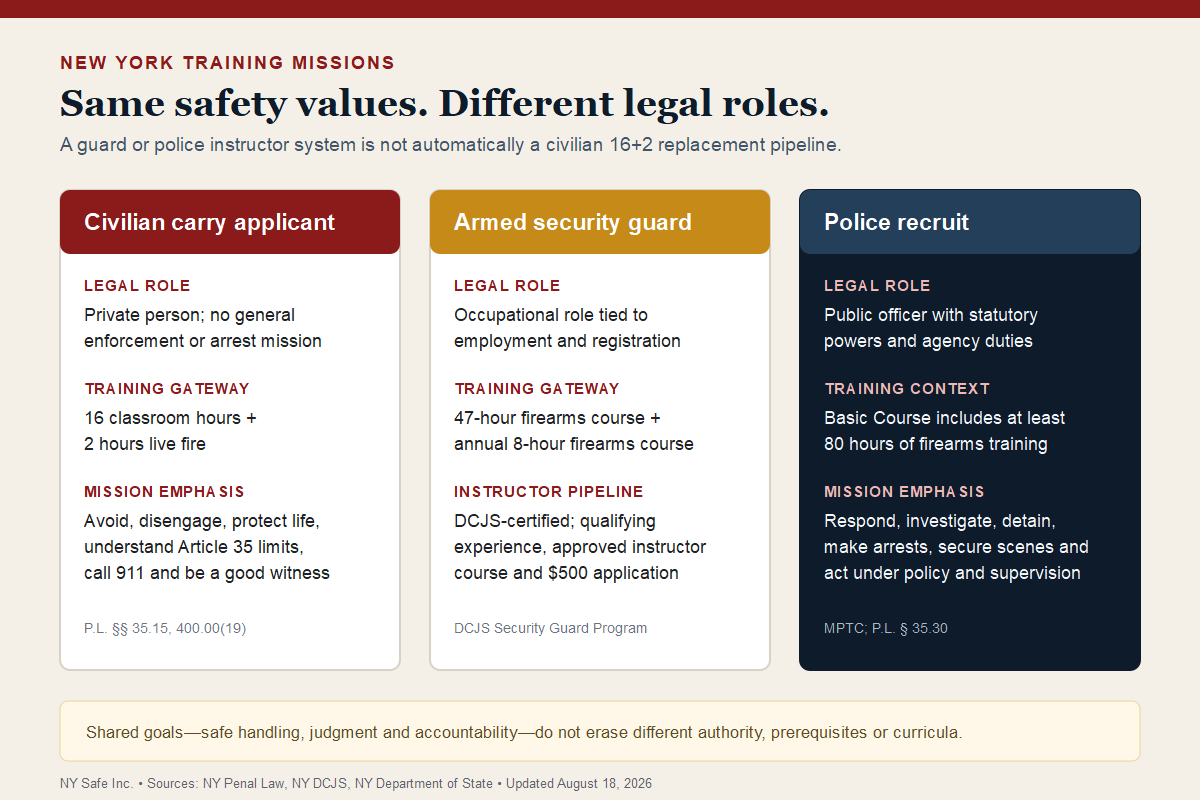
| Path | Legal and practical role | Training context | Why it is not automatically interchangeable |
|---|---|---|---|
| Civilian carry applicant | Private person; no general law-enforcement mission. | 16 classroom hours plus two hours of live fire; safe handling, law, conflict management, de-escalation, sensitive locations and marksmanship. | Civilian instruction must center avoidance, restraint, Article 35 and decisions made without police authority. |
| Armed security guard | Occupational role tied to employment, registration and assigned duties. | 47-hour firearms course plus annual eight-hour firearms training; separate guard-course requirements also apply. | The instructor credential has experience and program prerequisites that exclude many otherwise qualified civilian educators. |
| Police recruit | Public officer trained to respond, investigate, detain, arrest and act under law, policy and supervision. | The MPTC Basic Course includes at least 80 hours of firearms training plus force decision-making and scenarios. | Police training serves a broader public-duty mission and statutory powers that a carry license does not confer. |
New York law makes the distinction concrete. Penal Law § 35.15 governs civilian defense of a person and includes fact-specific limits involving necessity, aggression and retreat. Section 35.30 separately addresses force used by police and peace officers in arrests and preventing escapes. Police experience can be enormously valuable, and many officers teach civilians well. The point is specialization: instructors must translate experience into the narrower authority and defensive mission of an ordinary license holder.
For that civilian-side analysis, see NY Safe’s seven concealed-carry judgment tests, including why a license does not deputize its holder. Our related guide to what the police “duty to protect” cases actually mean explains why respect for law enforcement, personal preparedness and lawful restraint can coexist.
Where NRA credentials intersect with licensing: a verified sample
The following matrix is based on current statutes or agency materials reviewed through August 18, 2026. It is a confirmed sample, not a claim that only these jurisdictions recognize NRA training. “Layered” means the NRA credential is only an upstream qualification; separate state approval is still required.
| Jurisdiction | NRA credential’s role | Important limit or alternative | Primary source |
|---|---|---|---|
| New York | Express statutory route to “duly authorized instructor.” | Military, DCJS, DEC and 4-H routes also exist. | P.L. § 265.00(19) |
| Connecticut | Approved courses may include NRA courses and be conducted by an NRA- or state-certified instructor. | State certification and other approved organizations are alternatives. | Conn. Gen. Stat. ch. 529 |
| Rhode Island | NRA pistol instructors may certify the required shooting qualification. | Police range officers and AG designees may also certify. | R.I.G.L. § 11-47-16 |
| Massachusetts | Layered: NRA or another national credential can qualify an applicant for state instructor certification. | Massachusetts certification remains necessary. | 515 CMR 3.04 |
| Maryland | Layered: a national-organization credential supports QHIC status; the state guide expressly references NRA/USCCA. | MSP confirmation is required; a direct four-year QHIL route exists. | Maryland State Police |
| Washington, D.C. | Layered: an NRA Law Enforcement Instructor card is one example of formal training. | MPD certification, experience, syllabus, fingerprints and fees are still required. | MPD instructions |
| New Jersey | Regulation expressly recognizes NRA-certified instructors. | Current applicants must complete New Jersey’s CCARE protocol and use-of-force instruction. | NJSP CCARE |
| California | Layered: specified NRA instructor ratings qualify for a DOJ CCW-instructor application. | DOJ certification, COE and current live-fire qualification are required; other credentials qualify. | California DOJ |
| Illinois | Layered: ISP lists the NRA as an example of an approved instructor-certifying entity. | Separate ISP instructor certification and approved curriculum are required. | Illinois State Police |
| Iowa | NRA courses and NRA-certified instructors are express routes for an optional carry permit. | Other DPS-approved organizations and government instructors qualify; Iowa allows permitless carry for eligible people. | Iowa Code § 724.9 |
| Florida | A course conducted by an NRA-certified instructor is an express proof-of-competence route. | Multiple government, military and competition alternatives exist; licenses remain optional for many adults. | Fla. Stat. § 790.06 |
| Missouri | Statute expressly recognizes specified NRA instructor credentials and NRA safety instruction. | Other qualified-instructor routes exist; permitless carry changes the practical stakes. | RSMo § 571.111 |
| Nebraska | Layered: NSP cites NRA certification as a recognized prerequisite. | NSP approval and state curriculum remain required; USCCA is another route. | Nebraska State Patrol |
| Oklahoma | Layered: an NRA instructor school is one qualifying foundation. | Current CLEET certification and OSBI approval are required; other organizations qualify. | OSBI |
| Utah | Layered: NRA, POST or equivalent instructor training supports a BCI application. | Utah BCI instructor certification and curriculum are still required. | Utah BCI |
| Oregon | NRA courses and NRA-certified instructors are express statutory competence routes. | Hunter education, law enforcement and documented experience may also qualify. | ORS 166.291 |
| Michigan | The law uses generic “state or national firearms training organization” language; the NRA fits but is not named. | Other qualifying organizations can certify instructors and programs. | MCL 28.425j |
| Ohio | The law uses generic “national gun advocacy organization” language; NRA certification is a practical fit, not an exclusive statutory franchise. | Government-certified instructors and other routes qualify; licenses are optional for many adults. | ORC § 2923.125 |
The strongest objections—and the honest answers
“Other instructor organizations exist.”
Correct. USCCA, state academies, law-enforcement programs and other recognized organizations provide alternatives in some jurisdictions. That prevents “NRA certification is legally exclusive nationwide” from being true. It does not prove equivalent capacity, local coverage or a fast transition. Substitutability is an empirical question, and agencies should publish the data needed to answer it.
“The NRA created its own problem through waste and mismanagement.”
The LaPierre findings make that criticism legitimate. But punishing applicants with fewer lawful training options does not recover misspent money or improve nonprofit governance. The proper response is accountability plus continuity planning.
“Instructors are independent, so nothing would change.”
Independence reduces immediate risk. It does not eliminate renewal and replacement risk. In Maryland, for example, a state QHIC based on a national-organization credential expires with the underlying certification. NRA credentials themselves renew biennially.
“Permitless carry makes this irrelevant.”
It lowers the stakes in some states, not all. Optional permits can still matter for reciprocity, travel and other legal benefits. New York, New Jersey, Maryland, Massachusetts, Connecticut, Rhode Island, Illinois, California and D.C. retain licensing structures in which authorized training can directly affect lawful access.
“Government can simply take over.”
It can create a neutral alternative, but “simply” is doing too much work. New York would need qualification standards, instructor educators, examinations, recordkeeping, renewals, misconduct procedures, range capacity and geographic distribution. A paper credential without a production system is not a pipeline.
A nonpartisan continuity plan—without an NRA bailout
- Count the dependency. Each licensing agency should publish the number of active instructors by underlying credential, county and renewal date—without publishing sensitive personal information.
- Use neutral competency standards. Recognize any certifier that meets transparent curriculum, instructor-development, audit and disciplinary standards. Avoid replacing one private monopoly with another.
- Create a real public backstop. Build a state train-the-trainer route open to qualified civilians, not only police or security personnel.
- Adopt transition rules before a crisis. Specify how unexpired credentials, pending students, records and renewals will be treated if a certifier stops operating.
- Monitor access. Publish wait times, course prices and travel distance by region. A legal path that exists only on paper is not meaningful access.
- Preserve quality controls. Continuity must not become automatic approval. Require live-fire competence where law requires it, audits, complaint procedures and sanctions for fraudulent certificates.
Model continuity language—not current New York law
If an approved credentialing body ceases operations, instructor credentials valid on the cessation date should remain recognized until their stated expiration unless suspended or revoked for cause. The state should publish a transfer process allowing an instructor to qualify under another approved standard without duplicative fees or training when equivalent competency is documented.
Student course-completion certificates should remain valid under the rules in effect when issued, subject to ordinary expiration periods and licensing-authority review. Any enacted rule should also address pending students, custody of records, renewals, complaints and geographic access.
The principle
If government makes training a condition of exercising a constitutional right, government has a duty to ensure that the lawful training path is objective, safe, geographically available and resilient to the failure of any single private organization.
Journalist research desk
Reporters, researchers and policymakers may quote the following original NY Safe Inc. analysis with attribution and a link to this article:
“This is not a claim that the NRA is about to disappear. It is a warning that states have embedded private credentials in public licensing systems without measuring concentration risk or publishing a replacement plan.”
“New York requires 18 hours of training from a duly authorized instructor and expressly recognizes NRA certification, yet the public cannot see what share of the state’s civilian instructor capacity depends on that route. DCJS’s publicly linked security-school list contains 75 entries marked ‘Firearms: Yes,’ but that occupational delivery-site proxy cannot answer the civilian-capacity question.”
“Accountability for NRA mismanagement and continuity for lawful applicants are not opposing positions. A serious policy protects both donor integrity and public access to safe, compliant training.”
Five questions every licensing agency should answer
- How many currently authorized instructors rely on NRA credentials?
- How many applicants did they certify in the last twelve months?
- Which counties would fall below adequate capacity if those instructors could not renew?
- What happens to an existing certificate if the issuing organization ceases operations?
- How quickly can an instructor transfer to another approved credential without duplicative cost or a gap in authorization?
Core source library and methodology
- June 24, 2026 D.D.C. memorandum opinion
- NRA amended complaint (allegations, not findings)
- 1791 Foundation’s litigation position and documents (party assertions)
- Foundation 2024 audited annual report
- 2026 New York appellate decision affirming LaPierre judgment
- New York definition of “duly authorized instructor”
- NYSP/DCJS minimum training standards
- DCJS approved security guard school list dated February 19, 2025 (source for the 75-entry count)
- DCJS armed security guard instructor application
- MPTC police basic-course overview
- NRA instructor portal and renewal guide
For New York applicants: Review upcoming Nassau County 18-hour concealed-carry classes only after confirming the class and instructor credentials your licensing authority will accept.
Next Available Classes
Upcoming New York 16+2 CCW Class Dates
Limited to 15 students per class. Seats fill quickly.

Frequently asked questions
Has the NRA stopped certifying firearm instructors?
No evidence reviewed for this article shows that NRA instructor certification has stopped. Current NRA training and instructor portals remain online. This analysis addresses continuity risk, not a present shutdown.
Would existing NRA instructor certificates immediately become invalid if the NRA failed?
Not automatically in every jurisdiction. The result would depend on credential expiration, statutory language, agency decisions and transition rules. The larger exposure is likely to emerge during renewals and new-instructor certification.
Does New York require an NRA instructor?
No. New York names NRA certification as one route to “duly authorized instructor” status, but the statute lists other routes. The practical question is whether those alternatives have enough accessible civilian capacity to replace a large private network.
How many DCJS-certified armed-guard instructors are there in New York?
We did not locate a current statewide public count. DCJS’s February 19, 2025 approved-school list contains 75 entries marked “Firearms: Yes,” but schools and instructors are different units: an instructor may serve more than one school, and a school may use more than one instructor. The number should be described only as a dated delivery-site proxy.
Can police or armed-security instructors replace NRA-certified civilian instructors?
Some individuals may hold multiple qualifying credentials, and police or guard experience can be valuable. But the current DCJS armed-guard route is an occupational certification with experience, course and application requirements; it is not a general civilian train-the-trainer pathway. Any replacement system would also need sufficient educators, range access, geographic coverage, recordkeeping and transition rules.
Is this article taking a side in NRA v. 1791 Foundation?
No. Courts should decide the parties’ legal claims, and charitable assets must follow donor restrictions and governing law. The public-policy issue exists regardless of which party prevails.
Methodology and corrections
We reviewed current official statutes, regulations and agency instructions rather than relying on an AI-generated state list. We classified direct statutory recognition separately from state-layered approval and generic national-organization language. For the DCJS school figure, we counted all 75 occurrences of “Firearms: Yes” in the agency’s 34-page list dated February 19, 2025 and reproduced the count with a second PDF-text extraction. We did not treat school entries as instructors or compare them mathematically with the nationwide NRA figure. The jurisdiction table is intentionally non-exhaustive. Legal requirements change, and local licensing authorities may impose procedures consistent with controlling law.
If you are an agency, instructor, attorney or reporter with primary records showing the credential mix or a material correction, contact NY Safe Inc. We will review documentary evidence and update this article transparently.
Article update and correction log
- Version 1.0 — August 18, 2026: Initial legal, litigation and multistate source audit.
- Version 1.1 — August 18, 2026: Added the reproducible 75-entry DCJS count, public-data and training-mission graphics, verified internal links, S1472’s passed-Senate/Assembly Codes posture, denominator cautions and model transition language.
- Version 1.2 — August 18, 2026: Corrected the description of S1472 after reviewing the Senate-passed text: the bill leaves the NRA named, applies post-2028 DCJS recertification to all certificates issued under § 265.00(19)(a)(ii), and contains a date discrepancy between its operative text and sponsor memo.
- Version 1.3 — August 18, 2026: Improved visual hierarchy, table accessibility, internal navigation, journalist source shortcuts and related-reading context; no substantive factual conclusions changed.
Legal-information notice: This article is educational and is not legal advice. Applicants and instructors should confirm current requirements with the issuing authority before relying on any course or credential.

No responses yet