
NY Safe Inc. Flagship Analysis · Self-Defense Civil Liability · Reviewed August 16, 2026
The $10 Million Self-Defense Lawsuit: What Every Gun Owner Must Know About Civil Liability
A Portland civil trial has put a difficult question in national view: can a man convicted of burglary and menacing recover $10 million from the business owner who shot him? The headline is real; the conclusion that he will recover $10 million is not. This source-based guide explains the Oregon statute most summaries omit, why justification may be tested shot by shot, how New York differs, and what gun owners should examine before an incident.
Peter Ticali · Founder and Lead Instructor, NY Safe Inc.
NRA Endowment Life Member · NRA & USCCA Certified Instructor · Licensed Firearms Instructor: NY, MD, DC, MA, UT · NY Pistol License Holder Since 1992

Three-sentence executive summary
What this post solves
Quick answer: yes, an intruder can file a civil lawsuit after defensive force—but filing a complaint and demanding $10 million do not prove liability, case value, or a right to recover; in the Portland case, the plaintiff’s burglary and menacing conviction may support Oregon’s powerful felony-conduct defense, but that same statute withholds the defense if the force that caused the injury was not legally justified.
This guide solves the questions viral headlines collapse into one: what the Portland case actually establishes, how criminal justification differs from civil liability, when immunity or a felony bar may apply, why each shot can present a separate necessity question, how New York law differs, and whether an insurance policy may fund a defense or judgment.
Practical result: readers receive a seven-gate liability framework, a state-law comparison, verified statistics with limitations, a 15-question coverage audit, a prevention checklist, and a primary-source library—current through August 16, 2026; the responsible lesson is preparation and restraint, not a mythical promise that “a good shoot is case closed.”
Key takeaways
- A $10 million demand is not a $10 million judgment. It is a litigant’s request, subject to proof, defenses, judicial rulings, and a verdict or settlement.
- The Portland facts are disputed. Kenneth Voyles and James Grant describe materially different threats, movements, warnings, and shots. The jury—not a headline—must resolve them.
- Oregon law is more protective than viral commentary suggests. ORS 31.180 can create a complete tort defense when the plaintiff’s Class A or B felony substantially contributed to the injury, but not when the force was unjustified.
- Oregon does not impose a general duty to retreat before otherwise justified defensive force. That does not erase imminence, reasonable belief, necessity, initial-aggressor rules, or the requirement to stop when justification ends.
- New York is different. New York generally requires retreat before deadly force when the actor knows complete safety is available, subject to statutory exceptions, and separately authorizes deadly force in specified burglary circumstances.
- Homeowners coverage does not yield a universal answer. The duty to defend, intentional-injury exclusions, reasonable-force exceptions, business exclusions, criminal-defense restrictions, and reimbursement provisions must be read in the actual contract.
- Training should reduce the chance of firing. Distance, barriers, communication, 911, safe withdrawal, medical aid, and disciplined threat assessment usually protect more than marksmanship alone.
Case-status card
What the Portland case actually establishes—and what remains disputed
| Court and posture | Civil jury trial reported underway in Multnomah County Circuit Court, Oregon. No verdict was located as of this review. |
|---|---|
| Plaintiff | Kenneth Voyles, who was shot after entering the business. |
| Defendants | James Grant and Touchstone Granite & Marble Inc. |
| Reported demand | $5 million compensatory damages plus $5 million punitive damages. A demand is not an award. |
| Criminal resolution | Reporting says Voyles pleaded no contest and was convicted of first-degree burglary and menacing arising from the encounter. The precise effect in the civil case is governed by Oregon law and the trial record. |
| Core dispute | Whether Grant reasonably believed deadly force was necessary, including what Voyles did with bolt cutters and whether later shots occurred after the threat had ended. |
The attention-grabbing facts come from The Oregonian/OregonLive’s trial report. According to that account, Voyles entered a Northeast Portland countertop-fabrication business before dawn after pushing through a gate, removing plywood, and cutting through metal bars. He acknowledged intending to take a drill bag. Grant was inside the building.
From that point, the accounts diverge sharply. Voyles contends that he apologized and tried to leave, that Grant threw objects, that Voyles grabbed bolt cutters defensively, and that Grant retrieved a handgun and fired multiple times—including, Voyles alleges, after he was trying to escape. Grant reportedly says Voyles became aggressive, raised the bolt cutters, ignored commands, and created an immediate threat to his life.
Those are not interchangeable details. If a person is advancing with a heavy cutting tool capable of causing death or serious injury, the self-defense analysis is radically different from a shot fired at a person who is incapacitated or retreating. The law evaluates each use of force at the moment it occurs. An initially justified shot does not preauthorize every later shot; an initially retreating intruder can also become an imminent deadly threat. Sequence matters.
Oregon’s Judicial Department describes its free portal as providing court calendars and basic case information; it identifies the subscription OJCIN system as containing judgment dockets and the official Register of Actions. The filed complaint and complete trial record were not available through the ordinary indexed sources used for this review. For that reason, this article does not invent a docket number, quote a pleading we have not examined, or characterize an unreported order.
The missing legal center
Oregon’s felony bar is powerful—but it turns on justification
The most important Oregon statute in the civil case is not a generic “stand your ground” slogan. It is ORS 31.180, titled “Certain felonious conduct of plaintiff complete defense in tort actions.”
The statute provides a complete defense to a personal-injury or wrongful-death action when the injured person was engaged in conduct constituting aggravated murder, murder, or a Class A or Class B felony, and that felonious conduct was a substantial factor contributing to the injury or death. The defendant must establish that felonious conduct by a preponderance of the evidence.
That sounds case-ending—until subsection five. The statute expressly says the defense is unavailable if the injury or death resulted from physical force that was not justified under Oregon’s justification statutes. The structure is deliberate:
- Was the plaintiff committing the required category of serious felony?
- Was that conduct a substantial factor in producing the injury?
- Was the defendant’s force legally justified?
A “yes” to the first two questions does not excuse unjustified force. A “yes” to all three may provide a complete defense. That is why the criminal conviction can be enormously important without making the civil trial irrational.
What the no-contest conviction proves—and does not prove
Oregon law says a judgment following a no-contest plea is a conviction of the offense. But that does not make the plea an admission of every disputed fact in a later civil case. Oregon’s evidence code also excludes a judgment based on a no-contest plea from the specific hearsay exception that ordinarily covers certain criminal judgments. Those rules appear in ORS 135.345 and OEC 803(22)—not OEC 410, which addresses unaccepted or withdrawn pleas and related statements in criminal proceedings.
ORS 31.180 nevertheless asks whether the plaintiff was engaged in qualifying felonious conduct, and it directs the defendant to prove that conduct by a preponderance of the evidence. The parties can therefore litigate the underlying facts with admissible evidence even when the plea itself does not establish every disputed detail. Without the criminal judgment, pleadings, and trial rulings, this article does not predict the precise evidentiary or preclusive effect of Voyles’s conviction.
Timing matters under Harryman v. Fred Meyer
In Harryman v. Fred Meyer, Inc., 289 Or. App. 324 (2017), the Oregon Court of Appeals applied ORS 31.180 where store employees forced down and disarmed a man immediately after he shot another person and while he remained armed. The court held that the injuries occurred “at the time” of the Class B felony on that record and that the plaintiff bore the burden of proving the subsection-five exception for unjustified force.
Harryman does not establish that every injury occurring sometime after a felony is barred. The opinion stressed the immediate, continuing sequence and absence of evidence that the altercation had ended. Applied here, if the jury finds that any later shot struck Voyles after he was incapacitated or retreating and no statutory justification remained, subsection five would prevent ORS 31.180 from supplying a complete defense for injury caused by that unjustified force.
Where comparative fault may—and may not—fit
Oregon also has a comparative-negligence statute. For actions to which ORS 31.600 applies, claimant fault does not bar recovery when it is not greater than the combined fault of the persons specified by the statute; damages are reduced by the claimant’s percentage of fault. The statute also says it is not intended to create or abolish any defense.
That allocation rule is not a substitute for ORS 31.180’s complete defense or for proof that force was justified. Nor should anyone assume that negligence percentages automatically govern every intentional-tort theory. Which conduct may be compared depends on the pleaded claims, applicable defenses, parties, and Oregon law. The careful point is that civil litigation can involve both threshold defenses and, if liability remains, separate questions about allocating fault and damages.
Why the punitive-damages demand is a separate hurdle
Reporting describes the demand as $5 million compensatory and $5 million punitive. Oregon does not treat the punitive half as ordinary compensation. Under ORS 31.725, a party may not include a punitive-damages request in the initial pleading and must later obtain the court’s permission to amend based on specific facts and admissible evidence meeting the statute’s threshold. Because the full pleading and motion record were not available for this review, this article does not claim when or how that step occurred in this case.
Even after a punitive claim is allowed, ORS 31.730 requires clear and convincing evidence of malice or reckless and outrageous indifference to a highly unreasonable risk of harm, together with conscious indifference to health, safety, and welfare. Oregon also directs the distribution of a punitive award under ORS 31.735: generally 30% to the prevailing party, 60% to the state’s Criminal Injuries Compensation Account, and 10% to the State Court Facilities and Security Account. Thus, the reported $5 million punitive request is neither an ordinary damages valuation nor an amount that would automatically go entirely to the plaintiff.
What Oregon permits
ORS 161.209 permits physical force in defense of oneself or a third person when the actor reasonably believes another is using or imminently will use unlawful physical force, limited to the degree reasonably believed necessary. ORS 161.215 addresses provocation, initial aggression, and agreed combat.
Deadly force is narrower. Under ORS 161.219, it may be justified when the actor reasonably believes the other person is committing or attempting a felony involving the use or threatened imminent use of physical force against a person, committing or attempting burglary in a dwelling, or using or about to use unlawful deadly physical force against a person.
Premises and property have separate rules. ORS 161.225 authorizes force reasonably believed necessary to prevent or terminate criminal trespass, but deadly force only through specified gateways, including defense of a person or preventing arson or a felony by force and violence. ORS 161.229 authorizes only nondeadly force reasonably believed necessary to prevent or terminate theft or criminal mischief.
That is why “you can never use deadly force in connection with property” is too broad, while “you can shoot anyone stealing your property” is dangerously false. The correct rule depends on the statute, the type of premises, the offense, the threat to people, necessity, and the exact moment force was used.
Oregon has no general duty to retreat—but that is not immunity
In State v. Sandoval, 342 Or. 506, 156 P.3d 60 (2007), the Oregon Supreme Court held that the legislature did not impose an additional duty to retreat before using deadly force against an imminent use of deadly physical force. A 2026 Oregon Court of Appeals decision, State v. James, restated that Oregon has no duty to retreat before using self-defense.
Neither decision creates permission to pursue, punish, or continue firing after legal necessity ends. “No duty to retreat” answers one question. It does not eliminate reasonable belief, imminence, proportionality, initial-aggressor limits, or the statutory conditions for deadly force.
Criminal court and civil court ask different questions
| Question | Criminal proceeding | Civil proceeding |
|---|---|---|
| Who brings it? | Government prosecutor. | Injured person, estate, insurer, business, or another claimant with a recognized cause of action. |
| What is at stake? | Conviction, incarceration, probation, fines, and collateral consequences. | Damages, injunctions, costs, liens, business assets, and potentially insurance coverage. |
| Typical proof standard | Government must prove guilt beyond a reasonable doubt; state rules govern the treatment of justification. | Claims and affirmative defenses are commonly decided by a preponderance of the evidence, but allocations vary by state and issue. |
| Does no charge end it? | It ends that charging decision unless authorities lawfully revisit it within applicable limits. | No. A private claimant may still sue, subject to statutes of limitation, immunity, defenses, and preclusion rules. |
| Does acquittal control? | It bars another prosecution for the same offense within double-jeopardy rules. | Not automatically. An acquittal can reflect reasonable doubt rather than an affirmative finding that every act was justified. |
The Fifth Amendment’s Double Jeopardy Clause protects against specified repeat criminal prosecutions by government. It is not a general bar against a private damages action. Separate doctrines—such as claim preclusion, issue preclusion, statutory immunity, and evidentiary rules—may affect what can be relitigated, but they require their own analysis.
New York supplies a useful example of the different burdens. In the criminal context, once justification is sufficiently raised, the prosecution bears the burden of disproving it beyond a reasonable doubt. In a civil battery case, the New York Court of Appeals described self-defense as a defense the defendant must establish by a fair preponderance of credible evidence in Killon v. Parrotta, 28 N.Y.3d 101 (2016).
A prosecutor’s decision answers whether the government will pursue punishment under the criminal law. It does not issue a universal certificate covering civil liability, insurance, licensing, employment, or reputation.
Original NY Safe Inc. framework
The seven gates every self-defense claim must survive
“Was the shooting justified?” sounds like one question. In litigation it becomes a chain. A defender can have a strong answer at one gate and a serious problem at another.
- Jurisdiction and location. Which state’s law controls? Was the event in a dwelling, an occupied building, a business, a vehicle, or a public place? Those definitions can trigger different presumptions, retreat rules, or burglary provisions.
- Initiation and provocation. Who initiated or escalated the physical confrontation? Did either person withdraw and communicate withdrawal? A property owner does not automatically become the initial aggressor by confronting a trespasser, but the manner and sequence of confrontation still matter.
- Imminence. What unlawful force was occurring or about to occur at the instant force was used? Prior crimes and frightening character evidence cannot substitute for a present threat unless the jurisdiction’s statute makes that crime itself a qualifying gateway.
- Degree and necessity. Was the degree of force reasonably believed necessary? Deadly force receives the strictest scrutiny. Anger, punishment, and property recovery are not synonyms for necessity.
- Shot-by-shot sequence. Did the threat continue? Location of wounds, physical movement, video, audio, cartridge cases, medical evidence, and witness testimony may turn one encounter into several legally distinct moments.
- Evidence and credibility. Do the 911 call, body-camera footage, surveillance video, texts, social posts, firearm condition, physical scene, and statements corroborate the account? Small inaccuracies can be innocent under stress, but invented details destroy credibility.
- Civil protection and funding. Does the state provide immunity, a felony bar, fee shifting, or only an ordinary affirmative defense? Does an insurer owe a defense? Is the incident excluded because it involved business activity, an intentional injury, an unlicensed product, or conduct outside the contract’s definition of lawful self-defense?
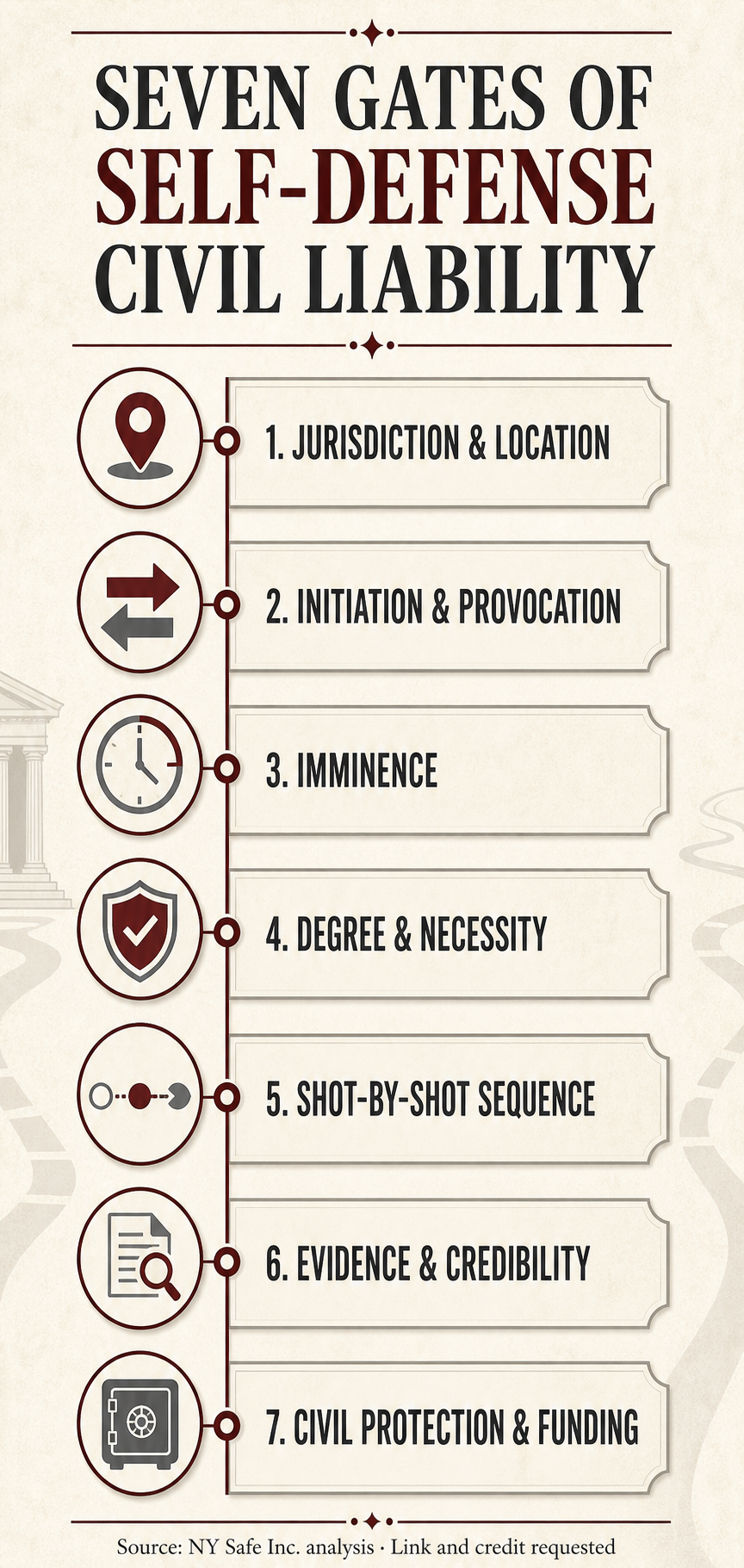
This framework is designed for analysis, training, reporting, and policy comparison. It is not a checklist for deciding whether to fire. In an emergency, the lawful objective is simpler: protect life, avoid the confrontation when safely possible, and stop using force when the threat stops.
“Stand your ground” and civil immunity are not the same law
Public discussion often treats retreat, castle doctrine, presumptions, criminal immunity, civil immunity, and attorney-fee reimbursement as one package. They are different legal tools. A state can eliminate a duty to retreat without granting civil immunity. It can grant immunity only after a judge finds the use justified. It can create a defense without paying the defendant’s litigation expenses.
| Model | Example | Practical meaning |
|---|---|---|
| Express civil immunity plus fee shifting | Florida Statutes § 776.032 | A person using force as permitted by the referenced statutes is immune from specified civil action; a court finding immunity in the civil case triggers an award of reasonable fees, costs, lost income, and expenses. |
| Express civil immunity | Texas Civil Practice and Remedies Code § 83.001 | A defendant whose force is justified under Texas Penal Code Chapter 9 is immune from civil liability for resulting injury or death. The justification predicate still must be resolved. |
| Felony-conduct complete defense with justification exception | Oregon ORS 31.180 | The plaintiff’s qualifying felony can defeat the tort claim, but not if the defendant’s force was unjustified. |
| Common-law public-policy bar | New York’s Barker/Manning doctrine | New York may bar recovery when injuries directly result from a knowing, serious criminal act, but courts warn that injury during some unlawful conduct is not automatically enough. |
“Immunity” also does not necessarily mean no investigation, no motion practice, and no expense. The defendant may first have to prove the conditions that activate immunity. Procedure—who bears which burden, when the hearing occurs, whether discovery pauses, and whether fees are recoverable—can be as important as the label.
New York focus
What New York gun owners must know
New York readers should not import Oregon, Florida, or Texas rules into a New York incident. Penal Law § 35.15 generally permits physical force when and to the extent a person reasonably believes it necessary to defend against another’s use or imminent use of unlawful physical force, subject to provocation, initial-aggressor, and agreed-combat limitations.
Deadly physical force is limited to listed circumstances. When the justification theory is that another person is using or about to use deadly force, New York generally requires retreat if the actor knows the necessity can be avoided with complete personal safety to the actor and others. The dwelling exception applies when the actor is in the dwelling and is not the initial aggressor. The statute also contains separate gateways involving kidnapping, specified forcible sex offenses, robbery, and qualifying burglary circumstances.
Penal Law § 35.20 is the reason “deadly force is only lawful to defend life, never property” is an unsafe oversimplification in New York. Subdivision three permits a person in possession or control of, or licensed or privileged to be in, a dwelling or occupied building to use deadly force against a person the actor reasonably believes is committing or attempting burglary there, when the actor reasonably believes deadly force necessary to prevent or terminate that burglary.
That is not a license to fire at every trespasser, shoplifter, vandal, or fleeing thief. The statutory terms “burglary,” “dwelling,” “occupied building,” “reasonably believes,” and “necessary” carry legal meaning. Section 35.20 separately limits the ordinary defense of premises and criminal trespass to nondeadly force, except through specified gateways.
For this purpose, Penal Law § 35.20 incorporates the Article 140 definitions. Penal Law § 140.00(3) defines a “dwelling” as a building usually occupied by a person lodging there at night; § 140.00(2) defines “building” more broadly and includes structures used for carrying on business. Those definitions are one reason a reader should never treat “my property,” “my business,” “an occupied building,” and “my dwelling” as interchangeable legal categories.
Can a person committing a crime sue in New York?
Sometimes a claim is barred; sometimes the illegal conduct is relevant to comparative fault; sometimes a duty never arose; and sometimes the lawsuit proceeds. New York’s rule is not “criminals have no rights.”
In Estate of Gambino-Vasile v. Town of Warwick, the court reviewed the Court of Appeals’ Barker/Manning doctrine. It explained that New York public policy can deny recovery when a plaintiff knowingly engages in a serious criminal violation and the claimed injury directly results from that violation. But the cases also say a complaint is not dismissed merely because the injury occurred during a criminal act. The connection, seriousness, parties’ conduct, and source of the claimed duty matter.
For New York license holders, a use-of-force incident can also create licensing consequences separate from both criminal guilt and civil liability. Licensing authorities may investigate possession, carry location, safe storage, conduct, and continuing eligibility. This article does not predict how NYC, Nassau, Suffolk, Westchester, or another authority would treat any specific case.
The numbers worth using—and the numbers we should stop inventing
The internet rewards large, precise figures. Evidence often does not. A fact-checkable authority page should identify what a dataset measures, its date, and its limits.
779,542
Estimated burglaries reported to law enforcement nationwide in 2024.
55.4%
Share of those burglaries categorized as involving forcible entry.
52.1%
Share involving residential properties.
4%
Estimated share of tort dispositions reaching bench or jury trial in BJS’s 2005 state-court study.
1.10 million
Estimated household burglaries in the 2024 NCVS—8.2 per 1,000 households.
28% / 7%
Resident present / violence experienced in a historical 2003–2007 BJS household-burglary study.
The burglary figures come from the FBI’s Reported Crimes in the Nation, 2024, released in summer 2025. The FBI estimated 5,986,400 property crimes; burglary was 13% of that total. Burglaries fell 50.5% from the 2015 estimate.
Those numbers establish scale and trend. They do not tell us how many buildings were occupied, how many occupants encountered intruders, how many intruders used force, how many defensive gun uses occurred, or how many shootings were legally justified. Reported-crime data also differ from victimization surveys that include incidents not reported to police.
Published in September 2025, the Bureau of Justice Statistics’ Criminal Victimization, 2024, based on the National Crime Victimization Survey, estimated 1,103,790 household burglaries in 2024, or 8.2 per 1,000 households. Unlike the FBI count, the NCVS includes victimizations reported and not reported to police and uses household-survey definitions. The two estimates answer different questions and should not be added together or treated as contradictory.
For encounter risk, the best directly relevant federal study we located is older and must be labeled accordingly. BJS’s September 2010 report, Victimization During Household Burglary, found that a household member was present in about 28% of household burglaries during 2003–2007 and experienced violent victimization in about 7% of all household burglaries. Among the burglaries where someone was present, about 26% involved violence. These historical household figures do not describe business burglaries, prove the danger level of a particular entry, or predict what an intruder will do. They do establish why “every burglary is a deadly attack” and “burglary is only a property crime” are both empirically careless claims.
The civil-trial figure comes from the Bureau of Justice Statistics’ Civil Justice Survey of State Courts. It is dated and should not be presented as a 2026 rate. Its useful lesson is narrower: most tort dispositions did not reach trial, punitive damages were sought in 9% of tort trials with plaintiff winners, and a prayer for damages should never be confused with a verdict.
Why this article does not choose one national defensive-gun-use number: Estimates vary widely because studies use different definitions, populations, survey questions, recall periods, and data sources. RAND’s Science of Gun Policy review explains that definitional and collection differences produce widely divergent annual estimates. More important here, the national frequency of defensive gun use cannot establish whether one person’s force was justified, whether a civil defense applies, or what one lawsuit cost.
What does a self-defense case cost?
There is no comprehensive national public database isolating attorney fees, investigators, experts, lost income, bail, civil defense, appeals, and insurance payments in civilian defensive-shooting cases. Complexity, location, charging decisions, counsel, experts, duration, and whether a case reaches trial create enormous variation.
A filing deadline is not a case-duration forecast. Statutes of limitation determine when particular claims generally must be started, subject to jurisdiction-specific accrual, tolling, notice, and repose rules. They do not predict when a lawsuit will end. Pleadings, document and electronic discovery, depositions, medical development, expert work, dispositive motions, insurance-coverage litigation, trial, post-trial motions, and appeal can each add time and expense. There is no reliable national “typical discovery timeline” for self-defense civil cases, so an incident demands prompt local legal advice rather than reliance on a generic online window.
That means the draft claim that defense “can easily exceed $100,000 to $250,000” should not be published as a typical or universal fact without a defined dataset. Some cases can cost less; complex criminal and civil trials can cost far more. The honest preparation tool is a cost inventory, not a fabricated average:
- Emergency criminal counsel and later trial counsel;
- Investigators, scene reconstruction, medical experts, and use-of-force experts;
- Depositions, transcripts, subpoenas, records, exhibits, and travel;
- Civil counsel, coverage counsel, business counsel, and appeals;
- Lost work, medical or trauma care, security changes, and licensing proceedings;
- Deductibles, uncovered expenses, judgments, interest, and collection risk.
Coverage audit
Do not buy a slogan. Read the contract.
Insurance notice: This section is general education, not coverage or insurance advice. A licensed insurance professional and qualified coverage counsel should review the actual policy or membership agreement.
The common statement that homeowners insurance always excludes self-defense because pulling a trigger is intentional is inaccurate. Policies vary. Some liability forms exclude injury expected or intended by the insured but contain language addressing reasonable force used to protect persons or property. Others use broader intentional or criminal-act exclusions. Business activity, location, insured status, weapons exclusions, and state public policy can change the result.
Coverage also contains at least two distinct promises. The duty to defend concerns whether the insurer must provide or fund a legal defense against covered allegations. The duty to indemnify concerns whether it must pay a settlement or judgment. A policy may trigger a defense based on allegations even when indemnity is later contested, or it may reserve rights and seek a coverage ruling.
Two New York cases show why wording and posture control
In Guzy v. New York Central Mutual Fire Insurance Co., 146 A.D.3d 1143 (3d Dep’t 2017), an appellate court held that the insurer had to defend a shooting suit. The allegations permitted a reasonable interpretation that the insured’s conduct was reckless, negligent, or otherwise unintentional, and the insurer had not shown that every interpretation fell within the expected-or-intended exclusion. That was a duty-to-defend decision, not a holding that every intentional defensive shooting must be indemnified.
In Leo v. New York Central Mutual Fire Insurance Co., 51 Misc. 3d 171 (Sup. Ct., Oneida County 2014), a trial court reached the opposite coverage result at the indemnity stage on different facts and wording. The policy had once contained an exception for reasonable force used to protect persons or property, but that language had been deleted from the policy in effect. The court held the intentional self-defense conduct excluded. Leo is a lower-court, policy-specific decision—not a universal New York rule—but it demonstrates why one endorsement can materially change the answer.
New York deserves special caution. In 2018, the New York Department of Financial Services fined Lockton $7 million over the NRA-branded Carry Guard program. DFS said the program unlawfully provided certain liability coverage for intentional wrongdoing and improperly provided criminal-defense coverage. The DFS enforcement announcement also distinguishes coverage for injury expected or intended from the insured’s standpoint that was “beyond the use of reasonable force to protect persons or property.” That enforcement history is one reason New Yorkers cannot assume that a product marketed nationally is lawful, available, or structured the same way here.
A membership plan is not necessarily insurance. Some products promise access to a lawyer, discretionary grants, reimbursement after acquittal, or benefits through a separate insurer. In 2022, Washington’s insurance commissioner reported that a court upheld enforcement against Armed Citizens Legal Defense Network for acting as an unauthorized insurer. The regulator said the organization had sold to more than 17,000 members nationwide, while 25 members filed claims from 2008 through 2019. That tiny and product-specific claim history cannot measure defensive incidents nationally, but it demonstrates why buyers should demand transparent terms rather than testimonials.
The 15-question self-defense coverage audit
- Is this insurance, a prepaid legal plan, a membership, or a discretionary assistance program?
- Who is contractually obligated to pay, and is that entity licensed or lawfully authorized in my state?
- Does payment occur up front or only by reimbursement?
- May I select counsel, and who controls litigation or settlement?
- Are criminal investigation and precharge representation covered?
- Are civil defense and civil judgments separate limits?
- Are experts, investigators, depositions, appeals, bail premiums, and licensing proceedings covered?
- How does the contract define lawful self-defense before a court has ruled?
- What happens after a guilty plea, no-contest plea, conviction, mistrial, diversion, or lesser-offense disposition?
- Can the provider recoup money already advanced?
- Does an intentional-injury or criminal-act exclusion contain a reasonable-force exception?
- Does coverage apply in a vehicle, another state, a workplace, rental property, or a business I own?
- Are family members, employees, domestic incidents, or prohibited locations excluded?
- What are the per-incident, per-person, annual, and aggregate limits?
- What notice deadline, cooperation clause, and consent requirement could forfeit coverage?
Ask the carrier or program to answer in writing and point to the operative clause. Marketing pages can change. The policy or membership agreement controls.
Why a business-owner shooting creates additional exposure
A self-employed person may think, “I acted personally, so this is my case.” A plaintiff may plead the opposite: that the owner was securing company premises, protecting company property, acting within a corporate role, or exposing the entity through negligent policies. That can put both personal and business assets, policies, and counsel into the dispute.
Commercial general liability coverage, commercial property coverage, workers’ compensation, employment practices, an umbrella policy, and a personal homeowners policy serve different functions. A CGL policy may contain assault-and-battery, expected-or-intended injury, firearms, security-operations, or designated-premises provisions. A personal policy may exclude business pursuits. An umbrella generally follows specified underlying coverage and is not a magic cure for an excluded event.
Small businesses should conduct a documented review with their broker and counsel before a crisis:
- Who is an insured when an owner, manager, employee, contractor, or security guard acts?
- Does any policy exclude weapons, intentional force, assault and battery, or security operations?
- Does the business have a written robbery, burglary, workplace-violence, and emergency plan?
- Are cameras positioned to preserve entry points, customer areas, cash-handling zones, and exits without invading prohibited privacy areas?
- Are recordings retained long enough, time-synchronized, backed up, and protected against routine overwrite after an incident?
- Do employees know that property can be replaced and that their first responsibilities are safety, distance, alarm activation, accurate reporting, and medical aid?
The best enterprise risk plan is not “arm everyone” or “disarm everyone.” It is layered: physical security, access control, lighting, alarms, video, cash and closing procedures, employee training, safe rooms or barriers where appropriate, emergency communication, first aid, lawful weapons policy, insurance, and counsel.
Practical risk reduction
Preparation is everything that makes the trigger unnecessary
Before an incident
- Learn your actual state law. Do not substitute a national map, instructor slogan, or neighboring state’s rule for current statutes and controlling cases.
- Train judgment under ambiguity. Decision scenarios should include unknown objects, fleeing persons, family movement, bystanders, mistaken alarms, intoxication, mental-health crises, and the need to stop.
- Create distance and barriers. A locked bedroom, office, counter, vehicle, or exit can buy time for identification, 911, and safe withdrawal.
- Harden the target. Quality locks, reinforced strike plates, maintained doors, alarms, lighting, trimmed sightlines, and camera retention reduce surprise and improve evidence.
- Plan family and employee movement. Decide who gathers children, who calls 911, where people shelter, and how responders will be met.
- Audit coverage annually. Confirm home, auto, umbrella, business, and any legal plan with written answers from licensed professionals.
- Avoid performative posting. Threatening jokes, “no warning shots” memes, revenge fantasies, and statements about killing intruders can become evidence of state of mind.
Immediately after force is used
No script fits every emergency, and nothing here overrides dispatcher instructions or police commands. General priorities are:
- Stop using force when the threat stops.
- Call 911, request police and medical aid, identify the location, and report continuing hazards.
- If it can be done safely, prevent additional handling of weapons or disturbance of physical evidence.
- When officers arrive, keep hands visible, follow commands, and understand they may not know who the defender is.
- Identify injured people, immediate threats, obvious evidence, and witnesses without inventing certainty you do not have.
- Request medical evaluation. Stress can conceal injury and impair memory.
- Obtain qualified counsel before giving a detailed formal statement. Do not lie, coordinate stories, delete recordings, hide evidence, or obstruct lawful process.
- Give prompt notice required by any potentially applicable policy or program, ideally with counsel’s guidance.
- Do not post, livestream, argue with commenters, contact the injured person, or try the case in public.
For New Yorkers who want a structured introduction to these responsibilities before deciding whether carry is right for them, NY Safe Inc.’s personal-protection and concealed-carry webinar addresses legal, practical, and personal realities without pressure to carry.
Hostile fact-check
The strongest objections—from every direction
“A convicted burglar should never be allowed to sue.”
Oregon largely recognizes the force of that objection through ORS 31.180. A qualifying serious felony that substantially contributed to the injury can be a complete defense. But the legislature expressly withheld that defense when the injury resulted from unjustified force. The rule protects lawful defenders without giving anyone a civil license to punish a person after legal justification ends.
“If no one was criminally charged, the lawsuit is harassment.”
Not necessarily. Prosecutors decide whether the government can and should prove a crime under a high standard. Civil claims test private legal duties under different standards. Some civil suits are weak, some are abusive, some reveal conduct the criminal system could not prove, and some are meritorious. Procedure exists to sort them; the mere filing does not answer which category applies.
“Civil liability chills legitimate self-defense.”
That risk is real when a justified defender must finance years of litigation before obtaining immunity or reimbursement. States can address it with early hearings, fee shifting, and precise immunity for legally justified force. The protection should attach to justification, not merely to the defendant’s status as a property owner or gun owner.
“Insurance encourages gun use by shifting the cost.”
Coverage design can create moral-hazard concerns, especially if it appears to promise payment for criminal or reckless acts. That is one reason states regulate intentional-wrongdoing and criminal-defense coverage. The answer is transparent, lawful coverage tied to justified conduct and strong incentives for avoidance—not pretending legal-defense costs do not exist.
“More firearms make confrontations more likely to become lethal.”
Access to a firearm changes the consequence of a bad decision; responsible advocates should concede that plainly. It is why storage, temperament, sobriety, de-escalation, discrimination of threats, and law matter. It does not follow that every lawful owner is reckless or that defensive firearm use has no value. The policy question requires evidence about risks, benefits, substitution, and affected populations—not a conclusion extracted from one lawsuit.
“The article should tell defenders exactly what to say.”
A memorized script can become misleading when facts differ. The safe universal advice is narrower: summon help, identify urgent hazards and evidence, comply with lawful commands, do not lie or obstruct, and obtain counsel before a detailed formal interview. State law and the emergency control the rest.
The bottom line
The firearm may end the physical threat. It begins the accountability record.
The Portland case is not proof that a burglar is entitled to $10 million. Nor is the burglary conviction proof that every disputed shot was lawful. Oregon’s own statute captures the correct principle: serious felonious conduct can bar recovery, but only when the responsive force remains justified.
Responsible gun ownership is not measured by eagerness to use force. It is measured by the discipline to avoid preventable danger, identify the legal threshold accurately, protect innocent life, stop when the threat stops, preserve the truth, and accept that a firearm is a last-resort instrument—not a property-recovery tool or punishment device.
If you are preparing for a New York concealed-carry license, NY Safe Inc.’s New York 16+2 concealed-carry class teaches safety, Article 35, judgment, de-escalation, and live-fire fundamentals in a calm, professional setting.
Start with the decision, not the purchase
Our introductory webinar helps New Yorkers decide whether carrying fits their legal responsibilities, household, temperament, and safety plan.
Next Available Classes
Upcoming Personal Protection Webinar Dates
Live online. Register from anywhere.

Frequently asked questions
Can a burglar sue a homeowner or business owner who shoots them?
Yes, a complaint can be filed if procedural requirements are met. Whether the plaintiff can recover depends on state law, justification, immunity, felony-conduct rules, causation, comparative fault, evidence, and the claims pleaded. Filing is not winning.
Can someone sue even when no criminal charges are filed?
Yes. A prosecutor’s decision not to charge resolves that criminal charging decision; it does not ordinarily prevent a private claimant from filing a civil action. State immunity, justification, preclusion, limitations periods, and other defenses may still defeat or narrow the claim.
Does a $10 million lawsuit mean the case is worth $10 million?
No. A damages demand is a request. Recoverable damages must be supported by law and evidence, and defenses can reduce or eliminate recovery. Punitive damages typically require additional findings beyond ordinary compensation.
Does an acquittal prevent a civil self-defense lawsuit?
Not automatically. Double jeopardy limits repeat criminal prosecution; it does not generally prohibit a private civil claim. State immunity and preclusion rules may still matter.
What does Oregon ORS 31.180 do?
ORS 31.180 can provide a complete defense to specified tort claims when the injured person’s aggravated murder, murder, Class A felony, or Class B felony conduct substantially contributed to the injury or death. The defense is unavailable when the injury resulted from physical force that was not justified under Oregon law.
Is Oregon a stand-your-ground state?
Oregon’s Supreme Court has held that its deadly-force statute does not impose a duty to retreat before otherwise justified defense against imminent deadly force. That does not eliminate the remaining statutory requirements or create automatic civil immunity.
Does New York have a stand-your-ground law?
New York does not use a general no-retreat rule for every deadly-force encounter. Under Penal Law § 35.15, when deadly force is justified by another person’s use or imminent use of deadly force, the actor generally must retreat if the actor knows complete safety can be achieved, subject to statutory exceptions. Separate rules apply to specified crimes and premises circumstances.
Can deadly force be used only to protect life?
That slogan is too broad. Many states authorize deadly force through specifically defined crimes or premises circumstances, such as certain burglaries or arson, in addition to defense against deadly force. The exact statute and facts control. Ordinary theft or trespass alone generally does not authorize shooting.
Will homeowners insurance cover a self-defense shooting?
Possibly, depending on the policy, allegations, exclusions, reasonable-force language, location, business use, and state law. Defense coverage and payment of a judgment are separate questions. Obtain a written coverage review from a licensed professional.
What is the difference between an insurer’s duty to defend and duty to indemnify?
The duty to defend concerns whether the insurer must provide or fund a legal defense against covered allegations. The duty to indemnify concerns whether the insurer must pay a covered settlement or judgment. A defense may be owed even while indemnity remains disputed, depending on the allegations, policy language, and state law.
Is concealed-carry “insurance” always insurance?
No. A product may be insurance, a legal-services plan, a membership, reimbursement, or discretionary assistance. Identify the obligated entity, regulator, payment trigger, exclusions, limits, and recoupment rights.
What is the best way to reduce self-defense civil liability?
Avoid the preventable confrontation; know local law; use barriers, distance, alarms, and 911; train decision-making; stop when the threat stops; preserve evidence; obtain counsel; and audit insurance before an incident. None guarantees that a claim will not be filed, but each improves safety and the factual record.
Primary-source library and methodology
This analysis was reviewed through August 16, 2026. We separated statutes, holdings, allegations, convictions, administrative positions, empirical findings, and NY Safe Inc. analysis. We did not treat the damages demand as a valuation, a no-contest plea as proof of every civil allegation, or an inaccessible pleading as though we had read it.
- Oregon Revised Statutes Chapter 161—justification, self-defense, deadly force, premises, and property.
- Oregon Revised Statutes Chapter 31—ORS 31.180 felony-conduct defense and exceptions; ORS 31.600 comparative negligence.
- ORS 135.345 and OEC 803(22)—effect and evidentiary treatment of a no-contest conviction.
- State v. Sandoval, 342 Or. 506 (2007)—Oregon retreat holding.
- State v. James (Or. Ct. App. 2026)—current Oregon restatement.
- Harryman v. Fred Meyer, Inc., 289 Or. App. 324 (2017)—ORS 31.180 timing and subsection-five burden.
- Oregon Judicial Department case-record guidance.
- New York Penal Law § 35.15 and § 35.20.
- New York Penal Law § 140.00—“building” and “dwelling” definitions.
- Killon v. Parrotta, 28 N.Y.3d 101 (2016)—civil self-defense burden.
- Estate of Gambino-Vasile v. Town of Warwick—New York serious-illegal-act doctrine discussion.
- Congressional Research Service Constitution Annotated—double jeopardy and issue preclusion.
- Florida Statutes § 776.032 and Texas CPRC Chapter 83—illustrative civil-immunity statutes.
- Guzy v. New York Central Mutual Fire Insurance Co., 146 A.D.3d 1143 (3d Dep’t 2017), and Leo v. New York Central Mutual Fire Insurance Co., 51 Misc. 3d 171 (Sup. Ct., Oneida County 2014)—policy language, duty to defend, and indemnity.
- New York DFS Carry Guard enforcement announcement.
- Washington insurance regulator’s ACLDN enforcement summary.
- FBI, Reported Crimes in the Nation, 2024.
- Bureau of Justice Statistics, Criminal Victimization, 2024—current household burglary estimates from the NCVS.
- Bureau of Justice Statistics, Victimization During Household Burglary—historical 2003–2007 encounter data.
- Bureau of Justice Statistics, Tort Bench and Jury Trials in State Courts, 2005.
- RAND, The Science of Gun Policy, second edition—defensive-gun-use definitions and measurement limits.
For journalists, researchers, and publishers
Quote, share, and link to this resource
You are welcome to quote brief portions of NY Safe Inc.’s original analysis and seven-gate framework with clear credit to Peter Ticali, NY Safe Inc. Please link to the canonical article so readers can review the sources, qualifications, and future updates. Contact NY Safe Inc. before reproducing a full table, graphic, or substantial portion.
“Self-defense civil liability is not one question. It is a chain involving jurisdiction, provocation, imminence, necessity, shot sequence, evidence, and the civil protections or funding actually available.”
— Peter Ticali, NY Safe Inc.
“A $10 million demand is a request, not a valuation. Under Oregon law, punitive damages must clear separate pleading and proof thresholds.”
“No duty to retreat answers one question. It does not erase imminence, necessity, proportionality, or the duty to stop when justification ends.”
“A prosecutor’s decision does not issue a universal certificate covering civil liability, insurance, licensing, employment, or reputation.”
“The legal question is not whether you had a right to be angry. It is whether each degree of force was authorized and reasonably believed necessary at that moment.”
“The firearm may end the physical threat. It begins the accountability record.”
Suggested attribution: “Peter Ticali of NY Safe Inc., in the organization’s analysis of self-defense civil liability…”
Suggested reference title: The $10 Million Self-Defense Lawsuit: What Every Gun Owner Must Know About Civil Liability.

No responses yet