
NY SAFE INC. · NEW YORK SAFETY & PERSONAL PROTECTION
Be Your Own First Responder in New York: Facts, Judgment, and a Family Safety Plan
By Peter Ticali · NY Safe Inc. · Last substantively reviewed October 13, 2026
Your family needs a plan for the moments before help arrives. This guide gives you a household safety worksheet, realistic examples for New York routines, and a plain-English explanation of the legal boundaries that matter.
Preparation supports professional police and emergency medical services. Even when community crime totals improve, an emergency can still happen on your route or in your home. Knowing how to leave danger, call for help, and provide trained aid helps you work with responders when they arrive. The current dispute over police funding and leadership makes the question of dependable emergency help especially timely.
Educational information, not individualized legal or medical advice. The scenarios below are hypothetical teaching examples, not reconstructions of named crimes. No example guarantees safety or establishes that force would be lawful.
October 13 update: added documented DSA positions, the Tisch leadership dispute, the mayor’s response, and practical questions for evaluating police-capacity proposals.
Executive summary: what being your own first responder means
Being your own first responder means preparing to protect life during the time before professional help arrives: recognize danger, avoid escalation, move toward safety, call 911, and provide aid within your training. New York's current safety record contains both improvement and unresolved concerns, so neither a reassuring ranking nor an alarming campaign statistic should substitute for a household plan. Firearms can be one lawful protection option for eligible people, but judgment, legal knowledge, secure storage, and continued training belong in the decision from the beginning.
“Public safety is measured across a community. Personal safety is decided in a particular place, at a particular moment.”
— Peter Ticali, NY Safe Inc.
Start here: five useful steps for your household
- Make a plan: complete the family worksheet, with or without firearm ownership.
- Prepare to help: choose hands-on first-aid and bleeding-control training.
- Practice decisions: use the eight scenarios to discuss leaving, communication, and responsibilities.
- Know the boundaries: review New York self-defense law before assuming a tool gives you authority to act.
- Check the evidence: read the dated statistics and separate them from campaign claims.
A family safety worksheet worth saving
Print or save this worksheet and use it for one calm household conversation this week. It works for firearm owners and non-owners. Write actual answers and include children, visitors, pets, disabilities, and different work schedules; a plan is useful only if it fits the people who will use it.
Download the free one-page family safety worksheet (fillable PDF). Type your answers or print it for a household conversation.
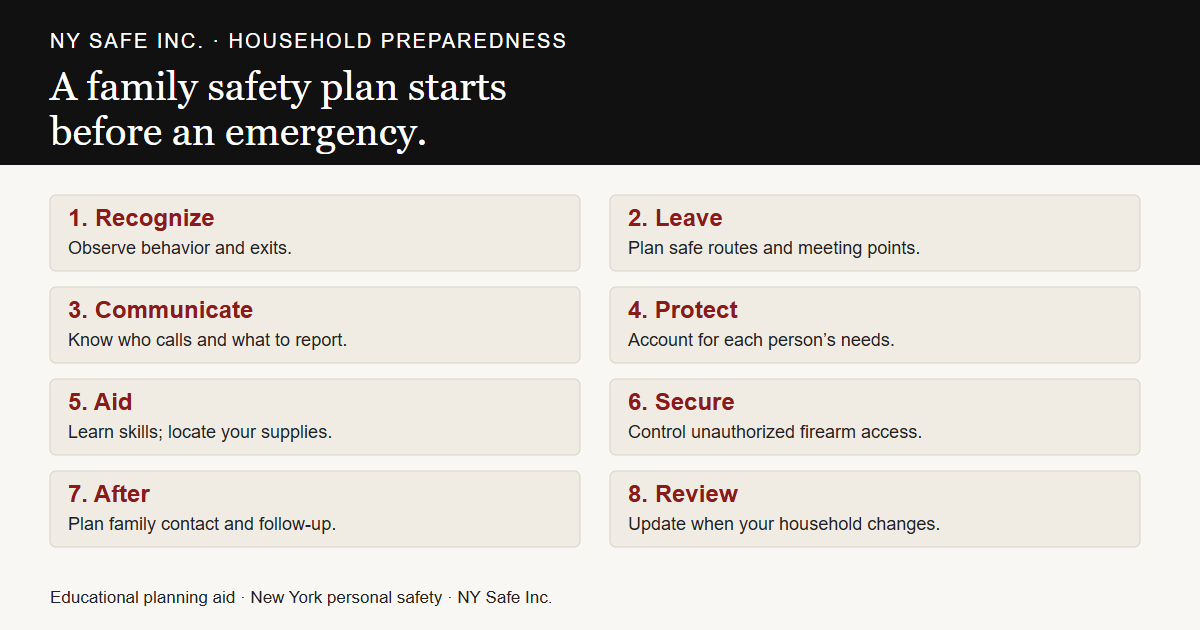
On a small screen, scroll the worksheet sideways to see every column.
| Priority | Write your plan | Practice safely |
|---|---|---|
| Recognize | What behavior would make us leave or call for help? | Discuss threats, pursuit, blocked exits, and medical distress. |
| Leave | What are our safe routes and meeting points? | Walk routes together without staging a surprise. |
| Communicate | Who calls 911? What location details matter? | Practice stating your address and entrance; do not place a practice 911 call. |
| Protect | Who helps children or someone with limited mobility? | Check that responsibilities fit actual abilities. |
| Aid | Where is the kit? Who has current first-aid training? | Locate supplies and arrange hands-on instruction. |
| Secure | Who can access firearms, keys, and combinations? | Review storage; conduct no live-fire or armed role-play exercise. |
| After | Who contacts family, preserves relevant records, and arranges follow-up? | Identify safe ways to retain original video and write down what you actually observed. |
| Review | What changed since our last discussion? | Revisit after a move, new routine, or household change. |
A simple weekend assignment: choose one routine journey, one home scenario, and one medical emergency. Identify the weak point in each plan and one achievable improvement. That may mean agreeing on a meeting location, making the address visible, replacing expired supplies, or scheduling training.
Discuss response to arriving officers too: keep hands visible, follow instructions, and avoid sudden movements. A responder may not yet know who belongs at the scene. Do not approach with a weapon in your hand to explain what happened.
The goal is a usable plan. If a household member cannot explain their role in ordinary language, simplify it. Preparedness should reduce confusion, not require everyone to memorize a complicated script.
Before help arrives: police response and medical readiness
Emergency response has several stages. Someone must recognize the problem, contact 911, communicate the location, and receive an appropriate response. Officers then have to reach the scene.
The Fiscal 2026 Mayor's Management Report lists NYC's average end-to-end response to critical crimes in progress at 9 minutes 38 seconds, compared with 9:10 in Fiscal 2025. Dispatch and travel alone averaged 7:15 in Fiscal 2026. These are citywide averages for defined call categories, not promises for your address or data for Nassau and Suffolk. NYPD chapter, printed pp. 48–49.
An average cannot tell you how long a particular incident will take. Nor can those numbers, by themselves, explain whether staffing, traffic, dispatch practices, or another factor caused a change. What they do make clear is that calling for help and acting safely while waiting are complementary responsibilities.
Learn to help someone who is hurt
Medical readiness belongs in the same plan. The American College of Surgeons warns that life-threatening bleeding can be fatal in 3–5 minutes. Its Stop the Bleed courses teach recognition and hands-on bleeding control. That is a reason to learn appropriate skills, not a prediction about every injury. ACS course and emergency-preparedness guidance · Find training.
In an ACS course, you practice direct pressure, wound packing, and tourniquet use with an instructor. The online lecture can introduce the material, but ACS requires in-person skills practice for course completion. Review what the course teaches and how the skills portion works.
Make readiness concrete: this weekend, choose who will take a Stop the Bleed course and where your household will keep an accessible kit. Check its condition and make sure others can locate it. Training and access to supplies are separate jobs; complete both.
A crash, a serious fall, or an injury at work can test your readiness without any criminal act. A useful protection plan includes the capacity to help, as well as the judgment to avoid becoming another casualty.
Eight teaching examples: turn concern into a practical response
The following hypothetical scenarios are discussion exercises. They teach choices and questions; they do not assign blame to victims or suggest that preparation can prevent every attack.
1. A train-platform argument moves toward your family
You are waiting with a child on an LIRR or subway platform. Two adults begin arguing, then one moves aggressively toward the other. Create distance from the confrontation and the platform edge, keep your child with you, and identify a safe route toward staff or an exit. Avoid moving through the dispute to reach a preferred stairway.
Teaching question: Before your next train trip, can each family member explain which adult to follow, where to move safely, and what to do if separated?
2. Someone behaves erratically near a station entrance
A person is shouting and pacing. Assess conduct and distance rather than attempting a diagnosis. Homelessness or apparent illness is not, by itself, a threat assessment. Give space; avoid insults, arguments, and crowding. If there is an immediate threat or medical emergency, reach safety and call 911 with observable details.
Komatireddy's treatment proposals raise a legitimate capacity question. The State Comptroller documented a historical loss of 990 inpatient psychiatric beds, or 10.5%, between April 2014 and December 2023. That figure does not describe current 2026 capacity or prove that a particular attack resulted from bed closures. Read the March 2024 capacity report.
Teaching question: Can you identify a route that gives the person space, avoids another hazard, and lets you report what you saw from safety?
3. A shoplifting incident escalates near the checkout
You see a customer shove an employee after being challenged. A shopper's responsibility is to protect themselves and the people with them, summon help from safety, and avoid joining a pursuit. Store owners should establish staff procedures before an incident: who calls, where people move, and how video is preserved.
Teaching question: Can an employee summon help without approaching the aggressor, and does everyone know where customers should move?
4. A driver follows you after a traffic dispute
You notice the same vehicle making repeated turns behind you. Do not lead a possible pursuer home. If you believe you are being threatened, contact 911 when safe, follow dispatcher guidance, and avoid pulling over to settle the disagreement. Keep driving lawfully; do not create a collision risk trying to prove a point.
Teaching question: Who can communicate your location and direction of travel while the driver keeps attention on driving safely?
5. You hear someone forcing an exterior door at night
Move family members away from the entry if you can do so safely, summon police, and use your planned protected location or escape route as circumstances permit. Avoid moving toward an unknown disturbance just to investigate. Tell dispatch where household members are and what you actually hear or see.
A legal rule that permits a response and your practical ability to carry it out safely are different things. Read our New York home-defense law guide for the separate legal questions.
Teaching question: Can a child, an older adult, or someone unable to use the stairs reach the planned safe location, and who will help them?
6. A threatening incident targets a house of worship
A visitor makes threats at an entrance. Attendees should follow the organization's emergency procedures, move away from danger, and alert designated staff or police from safety. A licensed attendee should not assume that possession of a firearm makes them part of a security team. Any armed-security arrangement needs its own legal and operational review.
Teaching question: Does the organization have a designated person to communicate with responders and a workable plan for children and people with mobility limitations?
7. A person collapses or bleeds heavily after a crash
First check whether approaching would expose you to moving traffic or another hazard. Summon emergency services. Follow dispatcher instructions and provide aid within your training. Know where your first-aid equipment is before the emergency, and learn how to use it in a hands-on course.
Teaching question: Who will call for help, who can bring the kit, and who has practiced the relevant first-aid skills with an instructor?
8. A firearm owner notices a storage gap
A visitor's child is coming over, or a household member's circumstances have changed. Review storage and access before the visit or change creates an emergency. Hiding a firearm is not the same as controlling unauthorized access.
New York Penal Law § 265.45 imposes storage requirements in specified household circumstances and for firearms left outside immediate possession or control in vehicles. Local requirements may add obligations. Read the actual rule rather than relying on a household assumption. Current safe-storage statute.
Teaching question: Before a visitor arrives or household circumstances change, who can reach the firearm, its keys, or its combination, and what must you change to control unauthorized access?
“Preparation should give you more choices before a crisis, and better judgment during one.”
— Peter Ticali, NY Safe Inc.
New York self-defense law: preparation must stay within legal boundaries
Being prepared gives you responsibilities. It does not give you police authority or permission to intervene in every conflict.
“You may” is not “you must”
Section 35.15 describes circumstances in which force may be justified; it does not command a civilian to use force. Legal permission is different from an obligation to confront someone. Choosing a safe exit, avoiding escalation, and summoning police can remain the better decision.
Is New York a stand-your-ground state?
Penal Law § 35.15 permits physical force to the extent reasonably believed necessary against unlawful force or its imminent use, subject to exceptions including provocation and initial aggression. Deadly force has additional requirements. Under § 35.15(2)(a), a person facing deadly force must retreat if they know they can avoid its necessity with complete safety to themselves and others; the dwelling exception requires that the person not be the initial aggressor. Other statutory grounds have their own conditions. Read § 35.15.
Premises and burglary rules are separately addressed in § 35.20. Being on your property does not create unlimited authority to use deadly force. Read § 35.20.
A license also does not resolve every question about possession, location, transport, storage, or use. If a decision depends on a disputed legal rule or your individual circumstances, seek qualified legal advice before building that assumption into your plan.
Teaching example: Someone steals an unattended bag and runs away. Recovering property and stopping an imminent threat to life are different objectives. A theft alone does not establish the legal basis for deadly force. Avoid turning pursuit into a new confrontation.
The questions to practice are practical: What did you reasonably perceive? Was there an imminent threat? Could you avoid it safely? What were other people doing? When did the threat change? The answer is tied to circumstances, not the political argument you read earlier that day.
NYC Crime Statistics 2026: What the Numbers Mean for Your Family
A crime trend is a comparison, not a complete description of your surroundings. Always identify the geography, dates, category, and unit before repeating a percentage.
A citywide or countywide figure cannot describe the specific neighborhood, station, or daily route your family uses.
Komatireddy's July advertising announcement said crime was up 26% under James. The release did not supply the underlying table, baseline, and endpoint needed to reproduce that figure. It establishes what the campaign claimed, not an independently verified measure for this article. Campaign advertising announcement.
The table below is a different comparison: NYC reported incidents in the first nine months of 2026 versus the same months of 2025. It does not verify, disprove, or reproduce a campaign claim about a different period or statewide geography.
For a current, bounded comparison, NYPD's October 6 release provides these preliminary counts for January 1–September 30 in each year:
On a small screen, scroll the table sideways to see every column.
| Measure | 2025 | 2026 | Change |
|---|---|---|---|
| Seven major crimes, total | 92,057 | 86,023 | −6.6% |
| Murder | 253 | 203 | −19.8% |
| Shooting incidents | 553 | 489 | −11.6% |
| Felony assault | 22,726 | 22,781 | +0.2% |
| Major transit crime | 1,613 | 1,628 | +0.9% |
| Confirmed hate crimes | 410 | 463 | +12.9% |
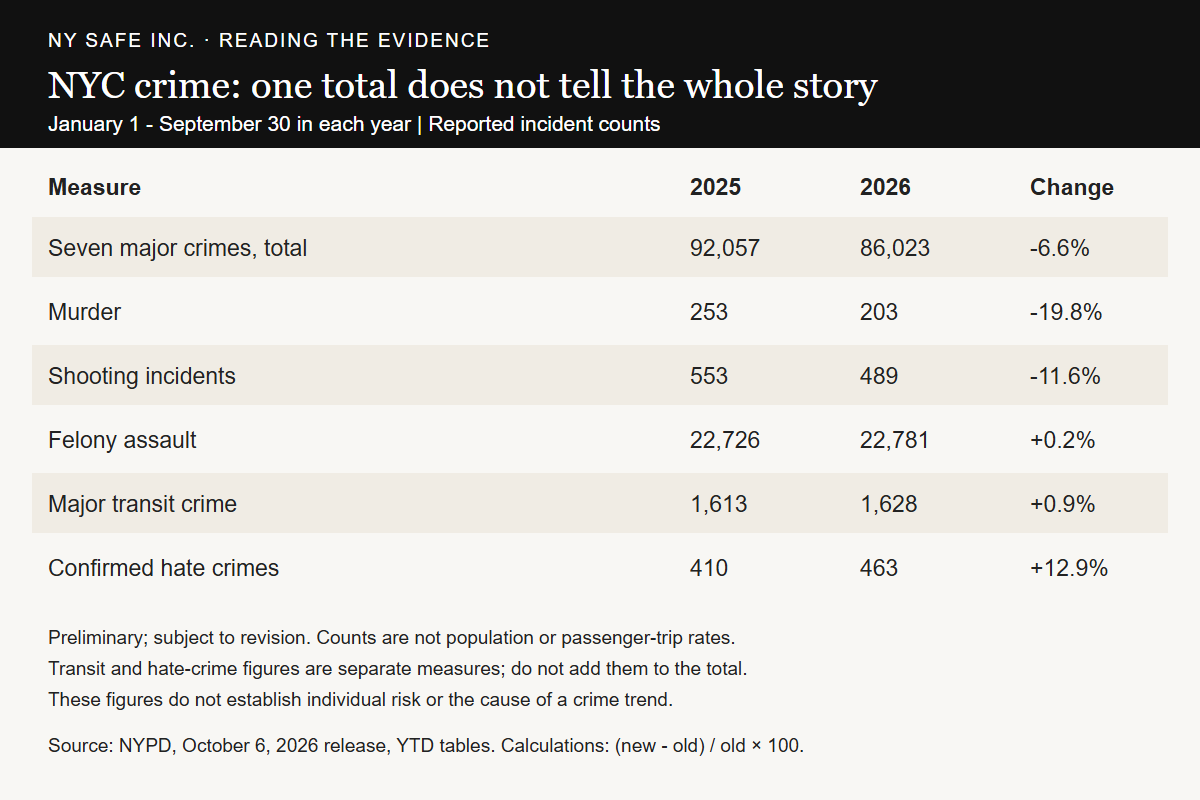
Source: NYPD October 6, 2026 release and tables. Counts, not population or ridership rates; preliminary and subject to revision. Transit and hate-crime figures are separate measures, not additional categories to add to the seven-crime total.
A count measures how many incidents were reported. A rate also accounts for a denominator, such as population or passenger trips. If ridership changes, the change in incidents per trip can differ from the change in the incident total; this table makes no claim about risk per ride.
The decline in the citywide total is welcome. It does not replace a plan for the places and times your family moves through every day. A rising category does not erase progress elsewhere, and these comparisons do not establish which policy caused the changes.
Five questions to ask before sharing a statistic
- Where? Nassau, NYC, outside NYC, and statewide totals answer different questions.
- When? A fiscal year, a calendar year, and a year-to-date comparison are different windows.
- What? A reported offense is not an arrest, a conviction, or a victimization survey response.
- Compared with what? Ask for the starting number, ending number, and calculation.
- What is missing? Reporting changes, unreported events, population shifts, and local variation can affect interpretation.
Practice example: If a hypothetical town goes from 10 incidents to 15, that is a 50% increase and five additional incidents. Both statements are true. Neither establishes your personal probability of victimization without more information.
For statewide and county comparisons, begin with DCJS's data library. Its 2024 criminal-justice footprint describes a slight index-crime decrease in 2024 after recent increases. Do not substitute NYC's seven-major-crime series for the state's index-crime series without checking definitions.
“A crime statistic needs a place, a period, and a definition before it needs a political explanation.”
— Peter Ticali, NY Safe Inc.
Defunding police and firing Tisch: what should a safety proposal demonstrate?
Police accountability and dependable police protection are both public-safety obligations. The current dispute over NYPD leadership makes that principle concrete. Proposals to remove leaders, abolish units, or reduce funding deserve scrutiny about which functions change, what replaces them, and how people remain protected during the transition.
What DSA demanded—and what the mayor has done
The New York Post reported on October 11, 2026 that the Democratic Socialists of America demanded Mayor Zohran Mamdani fire NYPD Commissioner Jessica Tisch and abolish the department’s Strategic Response Group and Community Response Team following the October 8 ICE shooting in Marble Hill. Those are reported organizational demands, not proof that the changes occurred. Read the October 11 report.
The New York City chapter’s separate October 9 statement made Tisch’s removal conditional on stopping the injustices it alleged. On October 13, Mamdani said he had no plans to remove Tisch. In an October 11 interview, he reiterated a pledge to disband the Strategic Response Group, according to amNewYork. A pledge to disband a unit, a demand to fire a commissioner, and an actual change in police operations are different things. Read the October 13 update and responses.
“Defund” is a documented position here
DSA’s National Abolition Working Group calls for rejecting police-budget expansion while “cutting budgets annually towards zero.” Its published 2026 program describes redirecting funding to public services as a step toward police and prison abolition. These are DSA’s stated organizational positions; they are not automatically the mayor’s adopted budget or the views of every person advocating police reform. DSA’s working-group demands · DSA’s published program.
The strongest argument deserves a serious answer
The strongest argument for changing police responsibilities is that misconduct must be investigated, force must be accountable, and some health or social-service needs may be better addressed by appropriate specialists. DSA’s program explicitly calls for treating addiction and mental illness as health issues and strengthening civilian oversight. Those objectives deserve consideration. They do not, by themselves, demonstrate that reducing or abolishing police capacity will preserve protection against violence.
My standard is practical: a proposal to reduce police capacity should identify which responsibilities disappear, which transfer, and who will perform them effectively. Promising future alternatives is not enough without a workable transition, trained personnel, adequate resources, and evidence that the replacement can meet the need.
- Response: Who answers a violent emergency, and how will dispatch and arrival times be measured?
- Capability: Who handles weapons, serious assaults, investigations, and calls requiring both police and medical expertise?
- Transition: What coverage remains while replacements are recruited, trained, and put into service?
- Accountability: How will misconduct complaints, use of force, and failures by replacement services be reviewed?
- Results: What evidence would justify continuing, revising, or reversing the change?
What this means for your household: support effective policing and lawful accountability, ask for operational answers, and keep your own plan usable. These October demands do not establish the cause of the earlier crime or fiscal-year response-time figures in this article. They also do not change a civilian’s legal authority to use force. The useful response is preparation—safe exits, clear communication, trained aid, and lawful judgment—not treating a policy dispute as permission to confront someone.
What the attorney general debate teaches about safety
The October 8, 2026 Spectrum News debate between Attorney General Letitia James and challenger Saritha Komatireddy put public safety and the office's priorities before voters. Spectrum's reporting described Komatireddy emphasizing mental illness and Medicaid fraud, and a dispute over James's handling of the Cornell University sexual-assault investigation. James defended her empathy for the alleged victim and promised an investigation based on evidence. These are reported positions, not findings about anyone's guilt. Read Spectrum's debate reporting and the full-debate page.
Teaching moment: compassion and evidentiary discipline belong together. Take a report of violence seriously. Help someone reach safety and appropriate support. Preserve relevant information. At the same time, distinguish what a person reports, what investigators can verify, and what a court ultimately decides.
That discipline matters beyond elections. If you witness a confrontation, you may see only its last few seconds. A person shouting may be an aggressor, a victim, or someone trying to summon help. Reporting observable conduct is more useful than filling the gaps with assumptions.
Example: “A person in a blue jacket struck another person near the north entrance” gives responders a starting point. “A dangerous criminal is attacking people” adds conclusions you may not be able to establish. Describe the conduct, location, direction of travel, visible weapons, and injuries you actually observe.
Komatireddy's post-debate statement separately emphasized repeat offenders and homelessness. Her September mental-health proposal called for treatment facilities and shelter oversight. Those are campaign proposals; this article does not treat the campaign's account of its own legal authority or likely results as an established conclusion. Post-debate campaign statement · September proposal.
Ask what each office can actually do
New York's attorney general has important responsibilities, but the office is not the ordinary prosecutor of every local crime. Executive Law § 63(2) provides a mechanism for gubernatorial direction to the attorney general to conduct specified criminal proceedings; other statutory grants also matter. A promise to take over a case therefore needs a legal mechanism, not merely a campaign commitment. Read Executive Law § 63.
Voters can ask useful questions: Who has authority? What funding is needed? What outcome will be measured? What safeguards apply? Families can ask an equally useful question: What can we improve this week while the policy argument continues?
What “Safest County” Rankings Actually Measure
Nassau topped the 2024 U.S. News public-safety ranking, according to contemporary reporting. The ranking included crime, injuries, and public-safety capacity, including access to emergency services. It was not simply a lowest-crime contest. Read the ranking's reported criteria.
Bruce Blakeman has made Nassau's safety record and law-enforcement hiring central to his public message. His campaign says he turned Nassau into the safest county in America. That claim deserves both recognition of Nassau's strengths and attention to chronology. Blakeman's campaign website.
PolitiFact's April 2026 review documented the designation before Blakeman took office in 2022, as well as during his tenure. It also reported that his office's hiring tally covered several public-safety job categories and that hires did not establish an equivalent net increase in police officers. Those details prevent us from treating the ranking as proof that one administration created Nassau's safety record. Read the chronology and staffing review.
Teaching moment: hiring is an input; operational capacity is the question. Ask how many people remain after retirements and departures, which jobs they perform, where they are deployed, and what response and prevention outcomes follow. A hiring announcement can reflect valuable investment while still leaving those questions unanswered.
For families, a good ranking is a reason to appreciate community strengths. It is not a reason to leave a door unlocked, abandon secure storage, or assume a loved one will know what to do in an emergency.
Repeat offenders: take the concern seriously and read the research completely
Repeat violence deserves focused attention. The evidence needs to identify the affected group, the legal rules, and the outcome being measured.
New York's current Criminal Procedure Law § 510.10 centers securing orders on assuring court appearance and sets out qualifying offenses for which bail or remand may be available. “Cashless bail” does not mean every defendant must be released in every case. Read the current bail statute.
John Jay's Data Collaborative for Justice published a 50-month study in October 2025. For cases made bail-ineligible, its NYC analysis found lower overall re-arrest under reform: 57% versus 66% in the weighted comparison group. It found no overall effect outside NYC, but worse outcomes for a smaller subgroup with recent prior violent-felony arrests. The study compared 2019 and 2020 cohorts using statistical adjustment; re-arrest is not conviction, and unmeasured differences remain a limitation. Read the study, executive summary pp. iii–v.
A separate May 2026 study of the initial January–June 2020 reform found a small increase in any re-arrest over a pretrial window capped at six months, with larger increases in its high-risk subgroup; longer follow-up attenuated the effects. Different law versions, methods, and observation periods matter. Read the researchers' abstract.
The strongest case for reform is that wealth should not decide who remains free before trial. A person presumed innocent can lose work, housing, or family stability through unnecessary detention, and the research does not support treating every release as a public-safety failure.
The strongest safety concern is that broad improvement can coexist with a smaller group associated with repeated serious harm. A policy should account for that risk rather than dismiss it as statistically inconvenient. The challenge is to identify effective, lawful safeguards, supervision, and interventions without substituting an accusation or poverty for evidence.
My judgment is that the useful question is which safeguards and interventions address demonstrated repeat harm while preserving due process. Calling every released defendant dangerous weakens that discussion. Dismissing every concern because an overall result looks favorable weakens it too.
What this means on a platform or sidewalk: a stranger’s criminal history is usually unknowable in the moment. Base your decisions on what you actually see and hear: threats, pursuit, assault, blocked exits, or a visible weapon. You do not need a theory about bail to leave a developing confrontation, and a suspicion about someone’s background does not supply legal permission to use force.
Choose the next learning step that fits your situation
You do not need to decide whether to carry a firearm before learning how to think about personal protection. Start with your daily life, household responsibilities, and willingness to train.
If you are still deciding
Our Should I Carry a Gun in New York? introductory seminar is a starting point for exploring protection options and the responsibilities of ownership. It is intended to help you make a thoughtful decision before buying equipment or beginning the licensing process.
If you have decided to pursue a New York carry license
Review the New York 16+2 concealed-carry class, including safety, legal use of force, situational awareness, and related responsibilities. Completing training is a step in the process; it does not itself authorize carry or guarantee licensing approval.
If you already have a license
Use the worksheet to identify what you still need to practice or understand. Read how to evaluate a New York CCW class, our guide to concealed-carry judgment, and the aftermath of a defensive shooting. Ask about instruction that addresses the gap you identify.
Pair firearms education, where appropriate, with separate first-aid and bleeding-control instruction. Competence in one area does not establish competence in the other.
Next Available Classes
Upcoming Personal Protection Webinar Dates
Live online. Register from anywhere.

Frequently asked questions
What does “be your own first responder” mean?
It means preparing for the time before professional help arrives: recognize danger, move toward safety, call 911, communicate clearly, and provide aid within your training. It includes prevention and judgment as well as any lawful defensive tools.
Do I need a firearm to improve my safety?
No. Household planning, awareness, safer routines, de-escalation, and first-aid education can all be part of preparedness. Firearm ownership requires a separate decision about eligibility, legal obligations, secure storage, and continued training.
Is New York City crime rising or falling?
It depends on the measure and period. NYPD’s preliminary first-nine-month comparison shows a lower seven-major-crime total in 2026, alongside increases in some other measures. The table above gives the counts and limits.
Does a “safest county” ranking mean my household needs no plan?
No. A ranking evaluates selected community measures. It does not guarantee that an emergency will not happen to you or that everyone in your household will know how to respond.
How quickly will police reach me?
No citywide average predicts an individual response. The figures in this article apply to NYC's defined call categories and reporting period. Your location, circumstances, and the response needed matter. Call promptly in an emergency and follow dispatcher guidance.
Is New York a stand-your-ground state?
No. Section 35.15 includes a retreat requirement under its deadly-force-defense provision when complete safety is known to be possible, with specified exceptions. Particular facts and other statutory grounds matter; the legal section above links the controlling text.
Does being in my home automatically justify deadly force?
No. A retreat exception is not unlimited permission to use deadly force. The threat, circumstances, and applicable statutory requirements still matter. Review the premises rules and home-defense guide linked above.
Does bail reform require the release of every person accused of violence?
No. The current statute specifies qualifying offenses and conditions for securing orders. Research results vary by group, law version, and follow-up period; they cannot decide an individual case.
Should I approach someone who appears mentally ill?
Do not attempt a diagnosis or assume that illness makes someone dangerous. Assess observable behavior and maintain appropriate space. If there is an immediate threat or medical emergency, reach safety and call 911 with clear details.
Which NY Safe program is a good starting point?
If you are still deciding about firearm ownership or carry, start with the introductory personal-protection seminar. If you have decided to pursue a New York carry license, review the 16+2 course. Choose instruction for your needs rather than treating a class as a guarantee of safety.
Can a household without firearms use this worksheet?
Yes. Safe routes, emergency communication, first-aid training, household responsibilities, and follow-up planning apply whether or not you own a firearm. If you do own one, include its lawful storage and access controls in the plan.
Does legal permission to use force mean I must use it?
No. The justification provision discussed in this guide describes when force may be permitted; it does not command a civilian to confront someone. A safe exit and a call for help may be the wiser choice.
Does an online bleeding-control lesson replace hands-on practice?
No. ACS offers an online lecture, but its course completion requires an in-person skills portion. Learn and practice the techniques with an instructor rather than treating an article, video, or equipment purchase as a substitute.
Quotable lessons for journalists and community leaders
The following are original commentary lines prepared for this article under Peter Ticali's byline, not quotations from candidates or investigators.
“A crime statistic needs a place, a period, and a definition before it needs a political explanation.”
“Preparation should give you more choices before a crisis, and better judgment during one.”
— Peter Ticali, NY Safe Inc.
Reporters can cite the dated data comparison, the linked original sources, and the household worksheet separately. Please distinguish NY Safe's educational analysis from agency findings and campaign statements. For educational or media inquiries, use NY Safe's contact route.
Sources, scope, and methodology
This guide separates reported debate remarks, campaign positions, statutes, agency counts, research findings, and NY Safe's practical judgment. The eight scenarios are hypothetical. This is a preparedness guide, not an estimate of your individual risk or a finding about the cause of a crime trend.
- Debate: Spectrum's October 8 reporting and full-debate page; the campaign's later release is identified separately. No unverified video transcript or timestamped quotation is supplied.
- Crime comparison: NYPD's October 6 tables, January 1–September 30 in both years. Percentage change is (2026 count − 2025 count) ÷ 2025 count × 100, rounded to one decimal. A reported count is not an exposure-adjusted risk.
- Police response: Fiscal 2026 MMR NYPD chapter, printed pp. 48–49. Fiscal-year averages are kept separate from calendar-year crime comparisons.
- Bail research: the October 2025 long-term report and May 2026 abstract are linked at the point of discussion. They study different windows; results cannot simply be merged.
- Historical mental-health capacity: the March 2024 Comptroller report is dated explicitly and is not presented as a 2026 bed inventory.
- Law: current online versions of Penal Law §§ 35.15, 35.20, and 265.45; CPL § 510.10; and Executive Law § 63, reviewed October 13, 2026.
- Police-policy update: DSA’s published program and working-group demands establish its stated positions; dated Post and amNewYork reporting establish the reported firing demands and the mayor’s response. Allegations, proposals, pledges, and operational changes remain distinct.
Sources are linked beside the claims they support so readers can inspect the evidence. Future data releases, statutory amendments, and corrections can change this record.
Make one useful improvement before the next headline
Support capable police and accountable public institutions. Ask candidates for evidence and measurable plans. Then give your household something it can use today: a safer routine, a clear emergency plan, better communication, or a new skill.
This week, complete the worksheet with the people you live with. Choose one gap to close: arrange hands-on first-aid training, identify a safer meeting point, or review access to stored firearms. Assign a person and a day to that task so the conversation produces a usable change.
If you want help choosing a learning path, start with NY Safe. If you are still weighing firearm ownership, begin with the personal-protection seminar linked above. The purpose is to make a sound decision and build the responsibilities that come with it.

No responses yet