
Second Amendment · Licensing · Civil Rights Enforcement
DOJ’s Virgin Islands Gun-Licensing Lawsuit: The Warning for New York
The federal pattern-or-practice case identifies how delay, discretion, unwritten conditions, and intrusive licensing can turn administration into denial—and why New York should pay attention.
By Peter Ticali — NRA Endowment Life Member · NRA & USCCA Certified Instructor · Licensed Firearms Instructor: NY, MD, DC, MA, UT · NY Pistol License Holder Since 1992
Founder and lead instructor, NY Safe Inc. · Substantively reviewed September 8, 2026
By Peter Ticali — NY Safe Inc. | Substantively reviewed September 8, 2026
The U.S. Department of Justice has done something gun owners are not accustomed to seeing: it has sued a police department for an alleged pattern or practice of violating the Second Amendment.
On September 2, 2026, the United States filed a First Supplemental and Amended Complaint against the Virgin Islands Police Department and the Government of the U.S. Virgin Islands. The 18-page pleading alleges far more than a disagreement over one permit. It describes a licensing regime in which officials allegedly delayed applications for months, demanded bolted-down safes without statutory authority, conditioned processing on warrantless home inspections, denied people for owning “too many” firearms, continued a proper-cause standard after Bruen, imposed limits not found in territorial law, and enforced newly enacted firearm restrictions that DOJ contends violate the Constitution.
That is the government’s case. It is not yet a judicial finding, and the defendants have not yet answered the amended complaint. But New Yorkers should study it closely, because the challenged methods resemble familiar features of New York licensing: long queues, a six-month statutory clock that may begin later than applicants expect, character references, interviews, household disclosures, broad “good moral character” review, and requests for whatever additional information an official considers necessary.
The parallel is not that every New York requirement is identical to every Virgin Islands practice. It is that a constitutional right can be obstructed administratively even when the government no longer says the word “deny.”
A right delayed by an agency-created queue, conditioned on unwritten demands, or subjected to open-ended character judgment is still a right burdened by government. The Constitution does not become optional at the licensing counter.
Key takeaways
- DOJ alleges a law-enforcement pattern involving delay, subjective licensing, compelled home access, unwritten conditions, and enforcement of challenged firearm restrictions. Those allegations have not yet been adjudicated.
- New York’s system is different, but applicants encounter comparable pressure points: character review, references, household disclosures, local intake procedures, and disputes over when the six-month decision clock begins.
- Under Bruen, the challenger must identify conduct covered by the Second Amendment’s text. Government then bears the burden of demonstrating a representative historical tradition supporting its restriction.
- Second Circuit decisions remain binding in New York unless altered by that court or the Supreme Court. Binding authority can still be criticized as wrongly reasoned when the analysis departs from controlling Supreme Court precedent.
- Applicants should follow current law, preserve a complete chronology, obtain unclear requirements in writing, and seek qualified legal counsel when delay or denial creates a serious legal issue.
Case status: what happened, and what has not happened
| Status point | Verified position as of September 8, 2026 |
|---|---|
| Court | U.S. District Court for the District of the Virgin Islands |
| Case | United States v. Virgin Islands Police Department and Government of the Virgin Islands, No. 3:25-cv-00050 |
| Operative pleading | First Supplemental and Amended Complaint, ECF No. 88, filed September 2, 2026 |
| Federal authority invoked | 34 U.S.C. § 12601, allowing the Attorney General to seek declaratory and equitable relief against a law-enforcement pattern or practice that deprives people of federal rights |
| Current posture | Allegations remain unproven; the court permitted amendment and suspended the earlier summary-judgment response schedule |
| Next docket deadline identified | Defendants’ response to the amended complaint due September 23, 2026, at 5:00 p.m. Atlantic time under ECF No. 83 |
| Relief requested | Declaratory and injunctive relief; the complaint does not request private damages |
This distinction matters. A complaint tells us what the United States alleges and what it intends to prove. It does not establish that every event happened as pleaded or that every legal theory will prevail.
What DOJ actually alleges
The amended complaint should be read in layers.
1. Delay as denial
DOJ alleges that the Virgin Islands licensing process routinely took many months and sometimes as long as a year. It also alleges that applicants could wait months merely to schedule a home inspection. In March 2026, according to DOJ, the department suspended all license issuance for weeks because of technical problems. Amended Complaint ¶¶ 59–63.
That matters because Bruen did not give “shall-issue” systems a permanent safe harbor. Footnote 9 said that licensing regimes using objective requirements are generally permissible, while warning that lengthy wait times or exorbitant fees could deny ordinary citizens their right to public carry.
2. A home-inspection condition
DOJ alleges applicants were told that refusal to admit licensing personnel into their homes would stop the application process, even though officials lacked probable cause or a warrant. The complaint frames this as both a Second Amendment burden and a Fourth Amendment problem.
The allegation is constitutionally serious because government ordinarily may not make one right the price of surrendering another. The defendants may dispute the facts, the characterization, or the asserted legal rule. But “consent” obtained under threat that an application will otherwise go nowhere is not an easy constitutional answer.
3. Rules that allegedly exceeded the law
The complaint says officials demanded an individually owned safe bolted to the structure even though territorial law did not require it. It also alleges that the department continued enforcing restrictions associated with the expired 1994 federal assault-weapons ban and applied a 10-round magazine limit without lawful territorial authority.
This is the most basic public-law principle in the case: an agency administers law; it does not get to invent criminally consequential conditions from habit, preference, or an internal checklist.
4. Subjective judgment
DOJ alleges denials based on an applicant having “too many firearms” and continued use of a “proper reason” or “proper cause” requirement after Bruen. If proven, those practices would place official discretion between an ordinary citizen and the exercise of a constitutional right.
Bruen invalidated New York’s demand that an applicant show a special need for self-defense distinguishable from that of the general community. Relabeling the same discretion would not cure it.
5. Challenges to the 2026 Virgin Islands statute
The official sources contain a one-day discrepancy that should not be hidden: the Virgin Islands Legislature’s bill tracker says Act No. 9113 was enacted June 24, 2026, while DOJ’s amended complaint says June 25. It addresses so-called assault rifles, magazines, suppressors, safety training, sales, accessories, and ammunition. DOJ alleges that enforcement of parts of the Act violates the Second Amendment, including restrictions involving AR-15-platform rifles, magazines over 15 rounds, suppressors, long-gun carry, storage, registration, and broad exclusion zones around protests, demonstrations, and “special events.”
These theories do not all stand on the same precedential footing. That is a feature of serious analysis, not a reason to soften the article.
The claim-strength audit: not every theory is equally settled
| Issue in DOJ’s complaint | Why the claim has force | What remains contested |
|---|---|---|
| Proper cause after Bruen | The Supreme Court invalidated New York’s special-need rule | Defendants may contest whether the alleged practice continued or how it operated |
| Months-long processing | Bruen expressly warned that lengthy waits may deny the right | No Supreme Court opinion creates a universal day limit for every application |
| Mandatory home access | Raises Fourth Amendment and unconstitutional-conditions concerns alongside the Second Amendment | Facts, consent, scope, and applicable inspection doctrine may be disputed |
| Unwritten safe and magazine rules | Agencies generally need legal authority for binding restrictions | Defendants may identify authority or deny the alleged practice |
| AR-15 and magazine restrictions | Heller protects arms in common use; the 2026 en banc Third Circuit *Cheeseman* ruling is highly relevant within the Virgin Islands circuit | The mandate was stayed on August 4, 2026; later proceedings and the exact reach must be monitored |
| Suppressor ban | DOJ relies on the Fifth Circuit’s 2026 Comeaux decision | That decision is not controlling in the Third Circuit |
| Universal registration | DOJ invokes the reasoning of then-Judge Kavanaugh’s dissent in Heller II | A dissent is not controlling law |
| Protest and event zones | Bruen and Wolford reject broad efforts to turn large areas into no-carry zones | Properly defined sensitive-place restrictions may still survive |
The honest conclusion is powerful enough: DOJ’s amended case combines straightforward allegations of permit obstruction with several cutting-edge Second Amendment claims. Readers, advocates, and journalists should not flatten them into a single “DOJ says all gun laws are unconstitutional” headline. The complaint itself says it is not bringing a facial challenge to every cited statute.
Why this case is unusually important
DOJ is suing under 34 U.S.C. § 12601, a statute commonly associated with pattern-or-practice cases involving police misconduct. The law authorizes the Attorney General—not private plaintiffs—to seek declaratory and equitable relief when law-enforcement officers engage in a pattern or practice that deprives people of federal rights.
This changes the frame. The alleged injury is not one mistaken denial. DOJ says the aggregate conduct constitutes an institutional pattern. Paragraph 108 expressly says that no single practice must establish the pattern by itself.
That approach offers a lesson for every licensing jurisdiction: administrative friction can become constitutional policy when it is repeated, tolerated, and built into the way an office operates.
DOJ has also treated delay as a Second Amendment enforcement issue elsewhere. In August 2026, it announced a settlement with Los Angeles County after alleging average waits of more than nine months for concealed-carry licenses. The agreement included staffing, technology, and process changes. This does not decide what delay is unconstitutional in New York, but it shows that the federal government now views licensing administration—not only statutory text—as a civil-rights concern.
Is this simply a political DOJ initiative?
The Civil Rights Division’s Second Amendment Section is newly established, and its selection of cases reflects the enforcement priorities of the current administration. Critics are entitled to scrutinize those choices. But that does not answer the legal claims: Congress enacted the pattern-or-practice statute in 1994, the amended complaint identifies specific alleged conduct, and every challenged practice must ultimately stand or fall on evidence and controlling law—not on whether a reader supports the officials who filed the case.
Virgin Islands and New York: a precise comparison
| Licensing pressure point | Virgin Islands allegation | New York rule or reported practice | Accurate takeaway |
|---|---|---|---|
| Subjective eligibility | “Proper reason” allegedly continued after Bruen; “too many firearms” allegedly used | “Good moral character” remains statutory, defined through character, temperament, and judgment | Different labels; both create risk when officials substitute broad discretion for objective disqualification |
| Delay | Many months to a year; inspection scheduling added delay | Penal Law § 400.00(4-b) says the licensing officer must act within six months after presentment, absent applicant-specific good cause stated in writing | The key dispute is often when the application is treated as complete or formally presented |
| Home and household scrutiny | Allegedly mandatory warrantless home inspection | State law calls for an interview and disclosure of spouse, domestic partner, adult co-residents, and minors in the home | New York does not impose the same statewide home-inspection requirement, but it reaches deeply into household information |
| References | Not central to the amended complaint | At least four character references are required for a carry license | The Second Circuit upheld denial of preliminary relief against this requirement in Giambalvo; that does not make the analysis beyond criticism |
| Social media | Not central to the amended complaint | Statutory language requests former and current social-media accounts from the prior three years | Enforcement was preliminarily enjoined in Antonyuk; readers must distinguish text still printed in the statute from what may currently be enforced |
| Extra-statutory demands | Safe, inspection, expired federal restrictions, and a 10-round rule allegedly imposed without authority | Local questionnaires and procedures can precede the state application in some counties | An agency cannot make its own queue or form the hidden gateway to the statutory clock without constitutional scrutiny |
| Storage | DOJ challenges a readiness-preventing rule | New York has multiple storage laws depending on circumstances | Heller invalidated a rule that made home-defense firearms inoperable; not every storage rule is therefore automatically invalid |
| Public carry zones | Broad event and protest exclusions challenged | New York’s Concealed Carry Improvement Act created numerous sensitive and restricted locations | Wolford confirms that states cannot recreate a broad carry ban through clever defaults untethered to historical tradition |
New York is also different in material respects. Its statutes contain defined disqualifiers and objective training hours, and some local offices have improved parts of their process since the immediate post-Bruen period. Those differences deserve credit where supported. They do not insulate subjective standards, hidden intake barriers, or excessive delays from constitutional review.
New York’s six-month clock—and the clock-start problem
New York Penal Law § 400.00(4-b) is unusually direct. An application must be accepted at presentment. The licensing officer generally must act within six months. A delay requires good cause, must relate specifically to the applicant, and must be explained in writing.
On paper, that sounds protective. In practice, a deadline protects applicants only if the government cannot postpone the event that starts the clock.
The Second Circuit confronted that problem in Giambalvo v. Suffolk County. Applicants alleged a local questionnaire and a wait of two to three years before the interview that allowed them to submit the formal state application. The court rejected a facial theory that every process longer than 30 days is unconstitutional, but it did not bless years of delay. It recognized standing and said the alleged wait could effectively deny the right to public carry, leaving room for as-applied challenges.
That distinction is essential. Giambalvo is not a judicial license for counties to take years. It is also not a statewide ruling that every reference, interview, or preliminary questionnaire is constitutionally ideal. It resolved the preliminary-injunction issues before it under the record and theories presented.
New York applicants should document:
- the date they first requested or attempted to submit the application;
- every form the agency required before accepting the state application;
- each payment, fingerprint appointment, interview, reference request, and follow-up;
- any statement that the file is incomplete, with the exact missing item;
- written reasons for any delay beyond six months; and
- the date and substance of every denial, suspension, or administrative closure.
The purpose is not confrontation. It is to preserve an accurate record. A licensing dispute often turns on chronology.
NY Safe’s New York 16+2 concealed-carry class explains the state training requirement and helps students understand how licensing documents fit together. Training is not legal representation, but applicants should leave knowing why dates, copies, and written instructions matter.
For a practical process overview, see How to Get a New York Pistol Permit: The Complete 2026 Guide and our detailed guide to New York pistol-permit character references.
The constitutional framework courts are required to apply
Heller: the right belongs to the individual
District of Columbia v. Heller held that the Second Amendment protects an individual right to possess and use arms for traditionally lawful purposes, including self-defense. It invalidated both a handgun ban and a storage rule that made lawful firearms unavailable for immediate defense in the home. It also identified the historical distinction between arms “in common use” and those that are “dangerous and unusual.”
Heller did not say every firearm rule is invalid. It did foreclose the idea that judges may reduce the enumerated right to whatever remains after government policy preferences are satisfied.
McDonald: states and local governments are bound
McDonald v. Chicago held that the right recognized in Heller is fully applicable to the states through the Fourteenth Amendment. New York, its counties, its cities, and their licensing officers do not operate outside the Second Amendment.
Bruen: government bears the historical burden
New York State Rifle & Pistol Association v. Bruen rejected the two-step interest-balancing framework used by the courts of appeals. The sequence is now:
- The challenger must show that the Second Amendment’s plain text covers the proposed conduct.
- If it does, the Constitution presumptively protects that conduct.
- The government must justify the restriction by demonstrating consistency with the Nation’s historical tradition of firearm regulation.
That is not the same as saying a plaintiff has no responsibility at all. The challenger must identify covered conduct. But once the text applies, government—not the citizen—carries the burden of historical justification.
When the Second Amendment’s text covers the possession, acquisition, or carrying of an arm, the constitutional presumption favors the citizen. The government must prove a representative historical tradition—not ask a judge whether its modern policy seems sensible.
Rahimi: principles, not a historical twin
United States v. Rahimi upheld the federal prohibition as applied to a person found by a court to pose a credible threat to another’s physical safety. The Court explained that a modern law need not be a “dead ringer” for a founding-era law, but it must be relevantly similar in why and how it burdens the right. Courts may reason from historical principles; they may not revive free-form interest balancing.
Wolford: the Supreme Court reverses the Ninth Circuit
In June 2026, Wolford v. Lopez held that Hawaii could not presumptively prohibit licensed carry on private property open to the public unless the owner gave express permission. The Court reversed the Ninth Circuit and concluded that Hawaii’s default departed sharply from the ordinary rule and burdened public carry without the required historical foundation.
That decision is directly responsive to anyone who says criticism of a circuit court is somehow improper. The Ninth Circuit’s judgment controlled until the Supreme Court reversed it. It was binding below—and wrong.
When a circuit court gets the Second Amendment wrong
Courts deserve precision, not immunity from criticism.
A lower court may be binding within its jurisdiction while its reasoning conflicts with the Supreme Court’s method. Those ideas are not opposites. Lawyers must advise clients about what current law requires. Journalists should describe the holding accurately. Citizens and advocates may still demonstrate why the decision diluted, misapplied, or evaded controlling precedent.
The disciplined formulation is:
- What did the court actually hold? Identify posture, record, remedy, and jurisdiction.
- Why is the reasoning wrong? Compare the court’s steps to the Supreme Court’s rule, not merely to a preferred outcome.
- What must people obey today? A disputed precedent remains operative until it is stayed, reversed, superseded, or distinguished by a court with authority.
That is how NY Safe will discuss Second Circuit decisions. We will not tell readers that an operative judgment vanished because we disagree with it. We also will not pretend that deference to precedent requires intellectual surrender.
Consider Antonyuk v. James. The Second Circuit kept a preliminary injunction against New York’s social-media disclosure while vacating much of the remaining injunction. Consider Giambalvo. The court declined broad preliminary relief against references, interviews, and training, but recognized that years-long processing could effectively deny the right. Those decisions currently matter in New York. Their continued force does not prevent a rigorous argument that a particular licensing burden lacks a sufficient historical analogue or restores the discretion Bruen rejected.
The same principle applies to the Supreme Court’s “common use” rule. A court cannot make common ownership constitutionally irrelevant by relabeling popular semiautomatic arms as unusually dangerous. Heller tied protection to arms commonly possessed for lawful purposes and contrasted them with dangerous and unusual weapons. Policy disagreement does not authorize a lower court to rewrite that test.
What Justice Ketanji Brown Jackson actually said
Justice Jackson’s separate opinion in Rahimi deserves accuracy. She did not accuse lower courts of deliberately refusing to follow Heller, McDonald, and Bruen. She criticized Bruen’s methodology and wrote that lower courts were “diverging in both approach and outcome” as they struggled to conduct the required inquiry. She also suggested that the blame might lie with the Supreme Court rather than the lower courts.
That is not an endorsement of the NY Safe position. Justice Jackson would prefer a different methodology. But her observation confirms an undeniable condition: post-Bruen outcomes have conflicted, and simply citing Bruen does not prove a court faithfully applied it.
The stronger pro-rights criticism comes from the law itself. Bruen rejected means-end scrutiny. Rahimi said some courts had misunderstood the methodology. Wolford then reversed a Ninth Circuit judgment that allowed a sweeping modern default. When a lower court shifts the historical burden, accepts an outlier as tradition, defines the right at an artificially narrow level, or smuggles public-policy balancing back into the analysis, it should be called out clearly.
The strongest gun-control objections—and where they succeed or fail
Serious gun-control organizations do not usually argue that rights are meaningless. Their strongest case is that licensing, training, references, interviews, storage rules, and location restrictions can reduce risk before a firearm is carried in public. Giffords, for example, expressly recommends references, interviews, record access, training, and review of objective indicators of danger. That position deserves a direct answer.
Objection 1: Bruen permitted shall-issue licensing
Correct—but only within limits. Bruen described objective shall-issue systems as generally permissible while warning that abusive discretion, lengthy wait times, and exorbitant fees may deny the right. The constitutional question is not simply whether a jurisdiction calls its system “shall issue.” It is whether an ordinary qualified person can obtain a timely decision under knowable standards.
Objection 2: References and interviews help identify dangerous applicants
They can verify identity, uncover material omissions, and develop facts relevant to genuine statutory disqualifiers. That is the strongest justification for them. The constitutional danger arises when verification becomes open-ended moral judgment, when applicants cannot know what satisfies the standard, or when an interview queue postpones the event that starts the decision clock. In New York, Giambalvo remains controlling on the preliminary-injunction record it reviewed; it does not convert every possible local implementation into a constitutional safe harbor.
Objection 3: Safe-storage checks protect children and prevent unauthorized access
Protecting minors and unauthorized users is a legitimate public-safety objective, and responsible owners should store firearms safely. But objective storage requirements and warrantless entry into an applicant’s home are not the same policy. Heller also establishes an outer limit: storage law cannot make an operable home-defense firearm unavailable when it is needed for immediate self-defense. The government must defend the actual means it chose, not merely identify a worthy goal.
Objection 4: Modern risks require flexible historical analogies
Rahimi agrees that government need not produce a historical twin. Courts may reason from principles embodied in representative historical regulations and compare how and why the old and new laws burden the right. That flexibility is real. It does not restore free-form interest balancing or allow an isolated, late, or materially different restriction to become a national tradition by assertion.
Objection 5: Licensing research associates permit systems with lower violence
Some public-health research cited by licensing advocates reports associations between particular licensing laws and firearm homicide or suicide outcomes. That evidence may inform legislative debate. It still requires careful attention to the law studied, time period, comparison states, confounders, and whether the research establishes causation. More importantly, under Bruen, favorable policy evidence does not replace the government’s constitutional burden once protected conduct is implicated.
Objection 6: The Virgin Islands is not New York
Correct. The governing statutes, alleged practices, officials, geography, and litigation posture differ. The article does not claim otherwise. The comparison is functional: both systems show how a nominally available license can be burdened through delay, subjective evaluation, preliminary intake barriers, or requirements not apparent from the governing text. Each New York practice must be evaluated on its own authority and record.
Objection 7: Heller said the right is not unlimited
It did. That sentence confirms that some firearm regulations are constitutional; it does not supply a blank check or a substitute test. Heller, Bruen, Rahimi, and Wolford still require courts to identify the right, examine the relevant historical tradition, and reject modern restrictions that cannot satisfy that inquiry.
The fair conclusion is not that every licensing safeguard fails. Objective, timely, legislatively authorized rules tied to genuine eligibility and supported by constitutional tradition stand on stronger ground. The problem begins when “vetting” becomes delay without accountability, discretion without an objective stopping point, or an agency-created condition that the law never authorized.
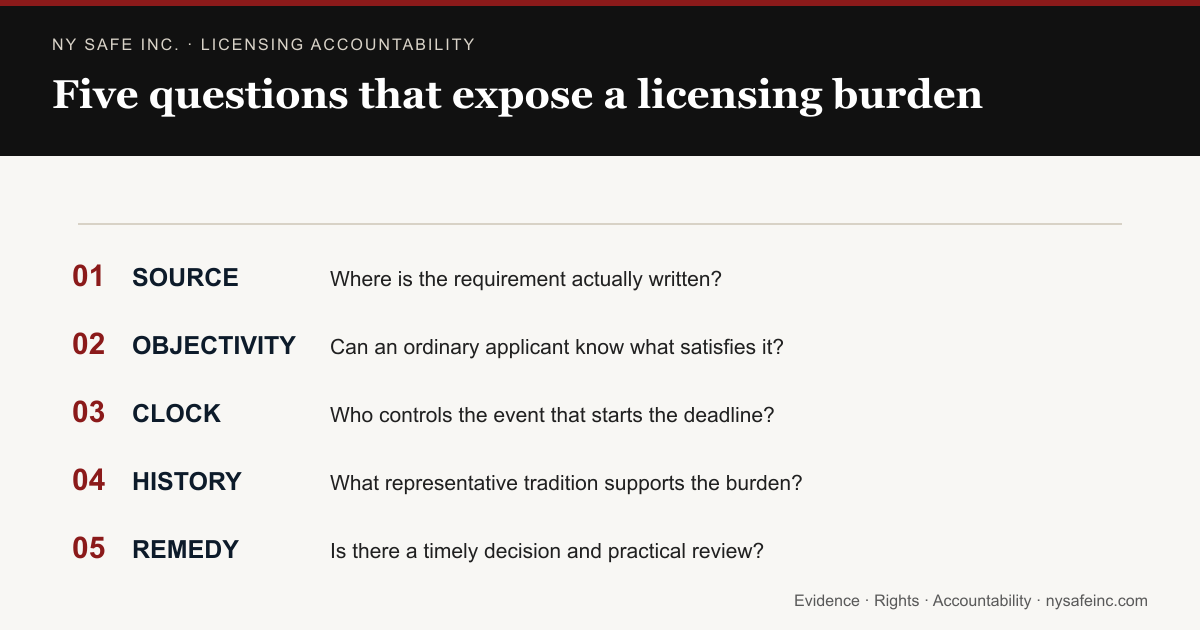
A five-question licensing-burden test
Before accepting a licensing requirement as routine, ask:
- Source: Where is the requirement actually written—in a statute, regulation, rule, or binding order?
- Objectivity: Can an ordinary applicant know in advance what satisfies it?
- Clock: When does the decision deadline begin, and can the agency control that trigger through a preliminary queue?
- History: If the conduct is covered by the Second Amendment, what representative historical tradition does the government identify?
- Remedy: Does the applicant receive a timely written decision and a practical path to review?
This framework is useful beyond this lawsuit. It converts a vague sense of administrative unfairness into questions that can be documented, litigated, reported, and answered.

What New York applicants should do now
The Virgin Islands lawsuit does not suspend any New York licensing rule. Do not carry, possess, acquire, or transport a firearm based on a prediction that a court will later invalidate a restriction.
Instead:
- follow the current written process while preserving proof of every submission;
- ask for unclear requirements and delay reasons in writing;
- distinguish a state-law requirement from a county practice;
- retain complete copies of forms, emails, receipts, reference requests, and notices;
- consult a qualified New York firearms attorney promptly if a delay, denial, suspension, or compelled disclosure raises a legal issue; and
- monitor the actual docket rather than social-media summaries.
Applicants facing broad character scrutiny may also find our analysis of licensing by association in *Wysocki* useful. For the post-Bruen cost problem, see One State, Two Prices: New York City’s Carry Rule After *Bruen*.
The bottom line
DOJ’s amended Virgin Islands complaint is important because it names the machinery of obstruction: delay, discretion, unwritten conditions, intrusive investigation, extra-statutory rules, and restrictions that treat the right as a problem to be managed rather than a command to be honored.
New York is not the Virgin Islands, and allegation is not proof. But New York officials should not miss the warning. Heller recognized the individual right and common-use principle. McDonald bound the states. Bruen rejected judicial interest balancing and placed the historical burden on government. Rahimi allowed principled analogy, not a return to policy balancing. Wolford proved in 2026 that even a federal circuit court can uphold a major gun restriction and still be reversed for getting the constitutional inquiry wrong.
Binding precedent tells citizens what rule a court will enforce today. Supreme Court precedent tells lower courts what constitutional method they are required to follow. When those diverge, responsible advocacy must acknowledge the first and fight—accurately, openly, and forcefully—for the second.
For journalists and researchers
Administrative friction becomes a constitutional policy when delay, discretion, and unwritten conditions are repeated and built into the ordinary operation of a licensing office.
Quotable lines
The following lines may be quoted with attribution to Peter Ticali, NY Safe Inc., and a link to this analysis:
- “A deadline protects applicants only if the agency cannot postpone the event that starts the clock.”
- “The Constitution does not become optional at the licensing counter.”
- “Binding precedent tells citizens what rule a court will enforce today; Supreme Court precedent tells lower courts what constitutional method they are required to follow.”
- Operative pleading: First Supplemental and Amended Complaint, ECF No. 88, filed September 2, 2026.
- Best pin cites: alleged licensing shutdown, ¶¶ 59–63; aggregate pattern theory, ¶ 108; no facial challenge, ¶ 109.
- Status warning: the complaint contains allegations, not findings, and this article must be updated as the docket develops.
Journalists seeking comment from Peter Ticali may use the contact information on NY Safe Inc.’s author and organization page or call 631-706-8700.
About Peter Ticali
Peter Ticali is the founder and lead instructor of NY Safe Inc., a Long Island firearms-training and Second Amendment education organization. He has held a New York pistol license since 1992 and teaches students navigating New York’s post-Bruen licensing environment.
NRA Endowment Life Member · NRA & USCCA Certified Instructor · Licensed Firearms Instructor: NY, MD, DC, MA, UT · NY Pistol License Holder Since 1992.
Frequently asked questions
Did DOJ prove that the Virgin Islands violated the Second Amendment?
No. DOJ filed an amended complaint containing allegations and legal claims. The defendants have not yet answered it, and the court has not issued a merits judgment on those claims.
Is DOJ arguing that every gun law is unconstitutional?
No. The complaint expressly says it is not a facial challenge to every cited statute. It challenges an alleged pattern of enforcement and particular restrictions.
Does the lawsuit change New York pistol-permit law?
No. It is a Virgin Islands federal case. It may become persuasive or informative, but it does not itself alter New York law or Second Circuit precedent.
Must New York decide every application within six months?
Penal Law § 400.00(4-b) generally requires action within six months after presentment, unless the licensing officer has applicant-specific good cause for delay and provides written reasons. Disputes can arise over completeness and presentment. Individual legal advice should come from a qualified attorney.
Are New York’s character references constitutional?
The Second Circuit in Giambalvo concluded that challengers had not shown a likelihood of success warranting preliminary relief against the reference requirement. That ruling controls within the circuit at its procedural level, but broader and as-applied questions can depend on the record and legal theory.
Did Justice Jackson say lower courts were defying Bruen?
No. She wrote that lower courts were diverging and struggling, while criticizing the Supreme Court’s chosen methodology. The article’s conclusion that some lower-court reasoning is wrong rests on comparison with controlling holdings, not on attributing that accusation to her.
Can a court decision be binding and wrong?
Yes. A lower-court decision remains binding within the rules of precedent until changed by an authorized court. Wolford is a current example: the Ninth Circuit judgment operated until the Supreme Court reversed it.
Further reading from NY Safe Inc.
- *Wolford v. Lopez*: What the Supreme Court’s 2026 Decision Means for New York explains the latest Supreme Court correction of a lower-court carry ruling.
- New York Sensitive Locations Law 2026 tracks where licensed carry remains prohibited and which rules are still being litigated.
- *Novotny v. Moore*: The Next Sensitive-Places Question examines the pending Supreme Court petition and its possible consequences for New York.
- The NY Safe Reality Test provides a broader seven-question framework for evaluating proposed firearm restrictions.
- How to Get a New York Pistol Permit is the practical starting point for applicants who need the process rather than the litigation analysis.
Sources and methodology
This analysis prioritizes the operative amended complaint, docket order, statutory text, official agency statements, and court opinions. It distinguishes pleaded allegations from findings, preliminary-injunction rulings from final merits decisions, majority opinions from dissents, and controlling authority from persuasive authority. Legal status was checked through September 8, 2026.
Primary sources include the September 2, 2026 amended complaint, DOJ’s original case announcement, 34 U.S.C. § 12601, Virgin Islands Act No. 9113 tracking, New York Penal Law § 400.00, *Heller*, *McDonald*, *Bruen*, *Rahimi*, *Wolford*, *Antonyuk*, and *Giambalvo*.
Educational information only; not legal advice. Laws, injunctions, agency practices, and case posture can change quickly.
Complete the training New York requires
NY Safe Inc. teaches the New York 18-hour concealed-carry course with an emphasis on safe handling, practical compliance, and an honest understanding of the law. Review upcoming classes below.
Next Available Classes
Upcoming New York 16+2 CCW Class Dates
Limited to 15 students per class. Seats fill quickly.


No responses yet