
Gun Policy · Constitutional Rights · Public Accountability
Gun Laws After Tragedy: What Australia and New York Must Prove
Australia’s post-Bondi debate and New York’s firearm data show why legislative activity, enforcement statistics, policy effects, and constitutional validity must be tested separately.
By Peter Ticali — NRA Endowment Life Member · NRA & USCCA Certified Instructor · Licensed Firearms Instructor: NY, MD, DC, MA, UT · NY Pistol License Holder Since 1992
Founder and lead instructor, NY Safe Inc. · Teaching New Yorkers through the post-Bruen licensing environment · Substantively reviewed September 8, 2026
After a mass killing, asking government to act is reasonable. Asking whether its response will work is equally reasonable.
Every murder, terrorist attack, domestic killing, and criminal assault is an intolerable violation of innocent life. Nothing in this article minimizes those acts, excuses a perpetrator, or argues that government must wait helplessly when evidence identifies a credible threat. The question is how a free society protects people without treating peaceable citizens as offenders in waiting.
The public deserves protection. Lawful firearm owners deserve more than an assumption that another burden on them will provide it. Those obligations belong in the same conversation.
A new gun law should be judged by the harm it can credibly prevent, the rights it must respect, and the results it produces. Passing legislation is the beginning of that accounting—not its completion.
Australia’s response to the December 2025 Bondi terrorist attack and New York’s firearm-enforcement debate offer a useful test. Neither supports a sweeping claim that regulation always works or always fails. Both expose the danger of confusing a legal restriction, an enforcement statistic, or a political announcement with demonstrated safety.
This is policy analysis and general education, not individualized legal advice. Australian developments do not change New York law. Specific possession, licensing, and self-defense questions require current, jurisdiction-specific guidance.
The quick answer
The strongest argument against a poorly designed gun law is specific: identify the failure, examine the proposed remedy, and ask what evidence connects the two. A policy’s public-safety purpose does not establish its effectiveness or settle its constitutionality.
For New Yorkers, the practical distinction is straightforward. Debate proposed reforms vigorously, but make personal decisions under the law that currently applies. An argument for changing a restriction is not permission to disregard it.
Key distinctions at a glance
- A bill introduced is not a law enacted; a law enacted is not proof of full implementation.
- Failure to prevent an attack is not necessarily proof that officials lacked legal authority.
- A decline in firearm deaths is not automatically a decline in total homicide, suicide, or violence.
- A firearm trace, an arrest, a conviction, and a prevented act are different evidentiary events.
- Evidence that a policy may help does not supply its constitutional justification; constitutional permission does not prove policy wisdom.
Australia’s repeal effort is real. A completed reversal is not.
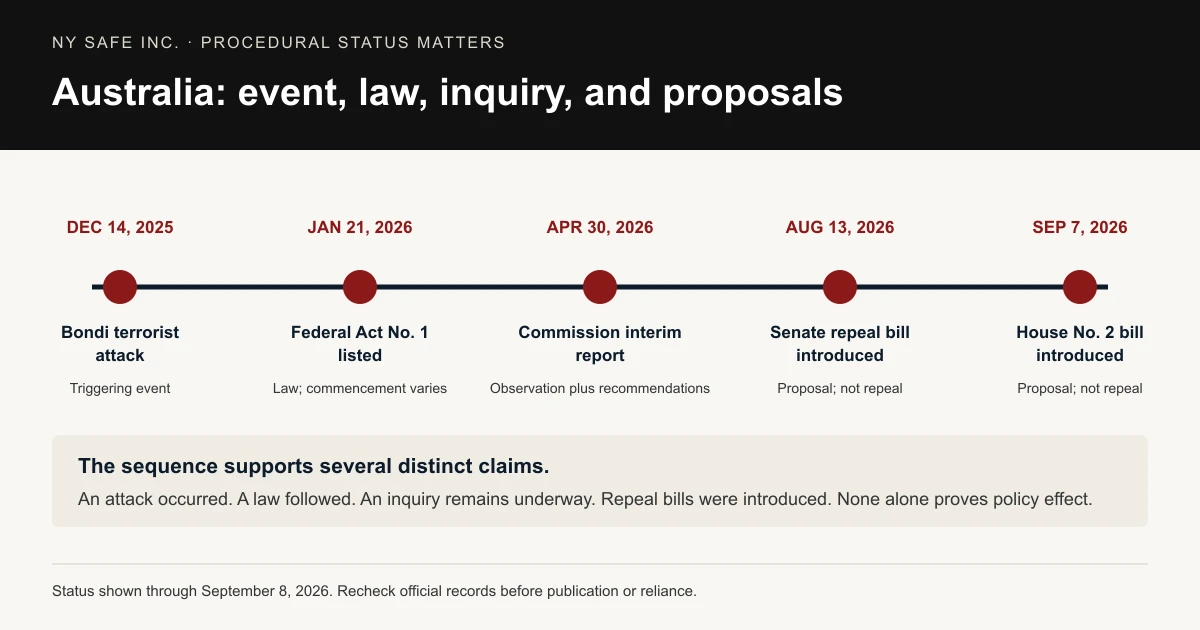
Australia’s federal register lists the Combatting Antisemitism, Hate and Extremism (Firearms and Customs Laws) Act 2026, No. 1 of 2026, as in force. The Act includes a national buyback framework, firearms background-check provisions, information sharing, and import-related changes. Different provisions have their own commencement rules; its overall status should not be mistaken for proof that every measure is fully implemented. Read the enacted Act and its commencement table.
The political challenge is also documented. Parliament’s current listings identify Senator Bridget McKenzie’s Firearms Legislation Amendment (Repealing Unfair Gun Laws) Bill 2026, introduced August 13, as before the Senate. David Littleproud’s similarly titled No. 2 bill, introduced September 7, is before the House of Representatives. These are proposals, not enacted repeals. Check the parliamentary listings.
McKenzie’s August 14 announcement argues that the new restrictions unfairly burden lawful owners and firearms businesses. That is the sponsor’s case for repeal, which deserves examination; it is not an independent finding about the laws’ effects. Read the sponsor’s statement.
The distinction matters. Introducing a repeal bill demonstrates opposition to legislation. It does not demonstrate that a country has abandoned its firearms framework, that a majority supports repeal, or that the disputed provisions have been empirically disproved.
For an American reader, Australia is a policy comparison, not a substitute for American constitutional analysis. A foreign policy result cannot establish the meaning of the Second Amendment.
What the Royal Commission actually said
The Royal Commission’s April 30 interim report contains a consequential observation: agency material identified no gap in existing legal and regulatory frameworks that impeded prevention of, or response to, an attack of this kind. Agencies did not suggest that the legal framework prevented them from taking prohibitive action before or on December 14, 2025. See the report’s introduction, printed page 8. Read the interim report.
But the same report recommends an updated, nationally consistent National Firearms Agreement and implementation of the proposed national buyback. Paragraph 8.38 also identifies intelligence-informed licensing as important and leaves further examination of licensing decisions ahead. See printed pages 89–90 and Recommendations 13–14. Read the published recommendations.
Those positions answer different questions: whether agencies lacked legal authority to act, and whether broader regulation might reduce future risk. The report is interim; its observation is not a finding that every existing rule worked or every new restriction is unnecessary.
That leaves a substantial accountability question: when officials propose a new restriction, what do they expect it to accomplish beyond the powers already available?
A government should be able to explain whether it is repairing a defect revealed by a particular attack or pursuing a broader preventive policy. Either rationale can be debated. Neither should borrow certainty from the other.
If the problem is how information reaches a licensing decision, the public should ask how the proposed measure improves that decision. If the objective is reducing the consequences of a future attack, officials should explain that objective and the evidence for it. The fact that both measures concern firearms does not make them interchangeable.
The strongest counterargument: some Australian reforms have evidence behind them
A credible gun-rights argument must confront research favorable to regulation. It cannot treat a later attack as proof that earlier reforms accomplished nothing.
In a 2016 JAMA observational study, Simon Chapman, Philip Alpers, and Michael Jones reported 13 mass fatal shootings during 1979–1996 and none during 1997–May 2016, using a threshold of at least five victims killed, excluding the perpetrator. Firearm deaths declined more rapidly after reform. However, the acceleration for firearm homicide alone was not statistically significant, and the authors could not attribute the change in firearm deaths to the reforms because nonfirearm deaths also declined. The study’s end date is essential: it is not a claim of zero subsequent mass shootings. Read the study abstract and methods summary.
A 2024 Health Economics study by Patrick Duenow and Luke B. Connelly used a synthetic control—a comparison assembled from other countries—to evaluate the buyback and related legislation. It found reductions in firearm homicide and firearm suicide, while reporting less robust evidence of substitution toward other means and no evidence of a net homicide reduction over its study period.
The study uses imputed Global Burden of Disease cause-of-death data and a donor-weighted comparator. Spain carried more than 80% of the weight in the main firearm-homicide comparison, although the authors report that the post-reform divergence persisted when Spain was removed. They describe the homicide-substitution evidence as weaker and less robust than the firearm-death result, and say volatility makes the extent of suicide substitution difficult to quantify. Those findings depend on the comparison, outcome, data construction, and period studied. Read the study, including its robustness tests and limitations.
These studies warrant more than a slogan. They also illustrate why asking whether gun control “works” is too broad. Works against which harm: mass shootings, firearm homicide, total homicide, suicide, or nonfatal injury? Compared with what alternative? Over what period?
The strongest case for access restrictions is preventive: a policy need not eliminate violence to reduce its probability or consequences. A person can also become dangerous after acquiring a firearm lawfully. That argument should be tested, not dismissed by saying that criminals break laws.
But evidence supporting an earlier package of reforms does not automatically validate every later addition. A new restriction needs a case for its additional benefit. And a finding about firearm deaths should not quietly become a claim about all deaths or all violent crime.
A tragedy cannot prove that every prior law failed. A favorable trend cannot prove that every new restriction is justified.
New York’s firearm traces: the denominator changes the claim
ATF’s 2024 New York report records 12,593 recovered-and-traced firearms, with a source state identified in 8,150 traces. New York accounts for 1,734 of those source-identified traces. The remainder is 6,416, or 78.7% of the source-identified subset. New York is the largest individual source state; the other jurisdictions combined account for a much larger share. See ATF’s source-state table and analytical criteria.
The calculation is (8,150 − 1,734) ÷ 8,150 × 100. It is statewide, not NYC-only. The other 4,443 traces lack an identified source state in that table.
| 2024 ATF New York trace measure | Result, with denominator |
|---|---|
| Total recovered-and-traced firearms | 12,593 — 100% of the report total |
| Source state identified | 8,150 — 64.7% of the report total |
| New York source state | 1,734 — 21.3% of the source-identified subset; 13.8% of the report total |
| Other source jurisdictions combined | 6,416 — 78.7% of the source-identified subset; 51.0% of the report total |
| Source state not identified | 4,443 — 35.3% of the report total |
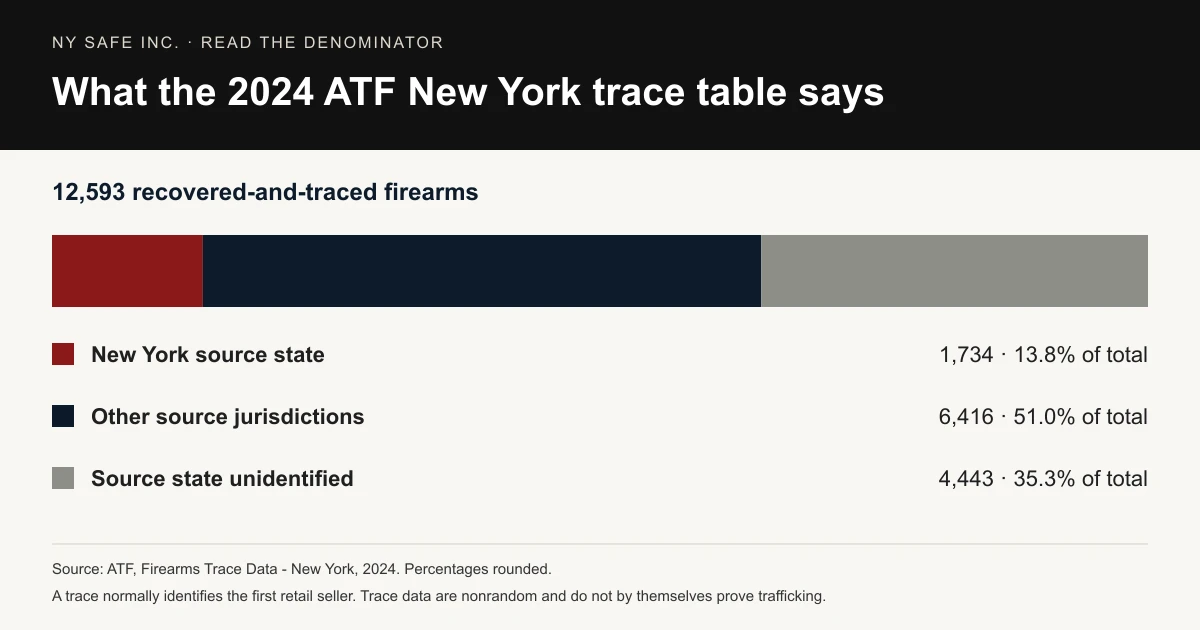
ATF cautions that traced firearms are not a random sample, not all traced firearms were used in crime, and tracing normally identifies the first retail seller. An out-of-state source does not by itself establish trafficking, the full transfer history, or the possessor’s conduct.
That makes the table an investigative starting point. It cannot, by itself, establish that a magazine restriction failed, that a licensing system succeeded, or that every interstate movement was illegal.
To test a trafficking claim, readers need evidence about diversion and unlawful transfers. To test a restriction intended to reduce injuries during an attack, they need evidence about those injuries. To test licensing administration, they need licensing data. One table cannot do all three jobs.
The fair objection to a policy is that its supporting evidence does not establish its claimed result. Claiming that the same incomplete evidence proves the opposite result merely repeats the error.
A possession arrest is not a measurement of violence prevented
The Amsterdam News reported on June 11, 2026, that illegal possession was the top charge in more than 42,700 of 63,386 NYC gun-related arrests during 2014–2024—more than 67%. The report attributes the analysis of state Division of Criminal Justice Services data to John Jay College’s Data Collaborative for Justice. This is an attributed finding from that investigation, not a fresh NY Safe analysis of individual arrest records. Read the investigation.
“Top charge” tells us how an arrest was classified. It does not establish all alleged conduct, a person’s history, the outcome in court, or whether a future offense was prevented. Arrests are not convictions, and arrest counts are not counts of unique people.
There is also a legal distinction that public debate often misses. New York Penal Law §265.03(3) addresses loaded-firearm possession without the unlawful-use intent element expressly included in subdivision (1). Section 265.03 is classified as a class C violent felony under §70.02(1)(b). Applicable exemptions and the facts still matter. Read §265.03 and §70.02.
A statutory violent-felony classification therefore should not be treated as a factual finding that someone fired at or injured another person. Conversely, the absence of a shooting charge does not turn unlawful possession into a minor paperwork error.
Police have a serious preventive argument: waiting for someone to shoot before intervening can be too late. But that argument needs evaluation. Officials should report what happened to cases, whom the intervention reached, what harms followed, and how those outcomes compare with a credible alternative.
An arrest total may document work performed. Demonstrating safety requires a different evidentiary step.
Constitutional rights require a separate answer
American constitutional law does not reduce the Second Amendment to a general weighing of policy benefits against burdens.
In New York State Rifle & Pistol Association, Inc. v. Bruen, No. 20-843, decided June 23, 2022, the U.S. Supreme Court rejected New York’s proper-cause requirement and the two-step approach combining history with means-end scrutiny. Justice Clarence Thomas’s majority opinion requires government, when the Amendment’s text covers the conduct, to establish consistency with the nation’s historical tradition of firearm regulation. See the majority opinion, pages 8 and 15. Read Bruen.
That does not mean government must wait for a completed violent crime. In United States v. Rahimi, No. 22-915, decided June 21, 2024, Chief Justice John Roberts’s majority upheld temporary disarmament in the circumstances of a court finding that an individual posed a credible threat to another’s physical safety. It rejected Rahimi’s facial challenge and reversed and remanded. See majority pages 16–17. The holding is not blanket approval of every preventive restriction. Read Rahimi.
The later decision in United States v. Hemani, No. 24-1234, decided June 18, 2026, illustrates the other boundary. Justice Neil Gorsuch’s majority held the prosecution under the federal unlawful-drug-user provision unconstitutional as applied to Hemani on the government’s marijuana-use theory. The Court affirmed; it did not invalidate every application of §922(g)(3). See majority pages 1–3 and 16–19. Read the revised Hemani opinion.
These decisions require careful attention to the law, historical justification, and application at issue. They do not support either blanket assumption that every restriction is valid or that every preventive rule is forbidden.
For policy debate, two questions should stay distinct: is the measure constitutional, and is it effective? Evidence of benefit does not replace constitutional justification. Constitutional permission does not prove that a policy is wise.
The cultural principle: free citizens are rights-holders, not risks to be managed
American law begins from a moral idea deeper than firearms policy: a person’s rights do not depend on convincing the government that he or she will never misuse them.
That idea is related to the presumption of innocence, but precision matters. The presumption of innocence is a rule governing the burden of proof in a criminal trial. The Supreme Court has not treated it as a universal prohibition on licensing, inspections, emergency orders, or every prospective safety regulation. Claiming otherwise would make the argument easy to defeat. Congress’s Constitution Annotated explains the doctrine’s criminal-trial scope.
The broader constitutional principle is due process: government may not deprive a person of life, liberty, or property through an arbitrary procedure. Due process often requires notice and a meaningful opportunity to be heard, while the precise safeguards depend on the interest, urgency, and risk of error. Review the Constitution Annotated overview of procedural due process.
The Second Amendment adds a separate substantive protection. Under Bruen, when its plain text covers the conduct, the government carries the burden of establishing a historical tradition that justifies the regulation. This is why ordinary policy balancing cannot define the right away. Legislators may consider safety and practical consequences; courts still must apply the Constitution’s rule.
Broad firearm rules also raise a civic question even when no individual has been accused of a crime. A categorical law can impose cost, delay, dispossession, or criminal exposure on people based on a legislative judgment about group risk. That does not make every categorical rule unconstitutional. It does require candor about who bears the burden, what conduct triggers it, how errors are corrected, and why a narrower measure would be inadequate.
A right is not a reward the government gives after a citizen proves permanent harmlessness. It is the starting position from which government must justify a deprivation.
That distinction is central to a culture of free citizenship. A government committed to equal liberty distinguishes demonstrated danger from statistical possibility. It does not claim omniscience about who might someday do wrong. When urgent circumstances support temporary action, it uses defined criteria, independent review, fair process, and an endpoint.
The danger of tyranny is not limited to a single dramatic confiscation. It can develop when emergency logic becomes ordinary governance; when temporary rules have no meaningful end; when officials need only invoke safety rather than establish authority; or when the people affected must prove they deserve the return of a right. “Tyranny” should describe that institutional danger with care. It should not be used as a substitute for analyzing a specific law.
This principle applies beyond guns. A free society does not abolish speech because some speakers threaten, erase privacy because some people conceal crimes, or eliminate procedural safeguards because some defendants are dangerous. It develops targeted rules for unlawful conduct and credible threats while preserving the right for the public at large.
Firearms present distinctive risks, and those risks can justify firearm-specific rules. But the existence of risk cannot answer every question about scope. The serious inquiry is whether a measure addresses the dangerous conduct, person, transaction, or circumstance with evidence and lawful process—or uses the wrongdoing of a few to place a permanent presumption against everyone.
What Everytown’s strongest preventive argument gets right
The most credible gun-control argument is not that every owner is dangerous. It is that waiting for a completed act can be fatal when reliable evidence already identifies an acute threat.
Everytown’s case for extreme risk protection orders illustrates that position. Its published framework says an emergency order follows evidence presented to a judge, a longer order requires notice and a hearing, the petitioner bears the burden, the respondent may answer the evidence, orders are time-limited, and extensions require further process. Everytown also cites studies associating these laws with reductions in firearm suicide, while acknowledging that researchers cannot know how many threatened mass attacks would otherwise have occurred. Read Everytown’s argument and cited safeguards.
The evidence deserves scrutiny. Everytown is an advocacy organization, and several claims on its page are stronger than the underlying designs can prove. Estimates of averted suicides depend on comparison methods; case series cannot establish that every intervention prevented a killing; implementation data vary across states and years. But dismissing the evidence merely because Everytown presents it would be the mirror image of accepting it uncritically.
More important, the safeguards in Everytown’s own model reveal common ground. A legitimate preventive system should ask:
- Is the concern tied to a particular person and current evidence?
- Does an independent decision-maker assess the claim?
- Does government or the petitioner carry the burden?
- Can the affected person see and challenge the evidence promptly?
- Is the deprivation no broader and no longer than the demonstrated risk?
- Is there a reliable path to correction and restoration?
- Are outcomes and errors reported so the public can evaluate the system?
That structure closely resembles the principle emphasized in Rahimi: an individual found by a court to pose a credible threat may be temporarily disarmed consistent with the Second Amendment. It also explains why Hemani matters: status alone did not justify the prosecution presented there when the government failed to connect the marijuana use to dangerousness or an adequate historical principle.
This is not a complete constitutional test for every law. It is a disciplined policy boundary. The further a proposal moves from individualized evidence, neutral adjudication, limited duration, and restoration, the stronger the government’s justification must be.
Prevention is most legitimate when it acts on evidence of danger. Collective suspicion asks millions of people to surrender liberty because government cannot identify who is dangerous.
Interest balancing: the accurate legal and moral objection
The phrase “interest balancing” needs two different explanations.
As ordinary policymaking, balancing is unavoidable. Officials compare benefits, costs, alternatives, enforcement resources, and unintended effects. Refusing to consider those factors would produce careless law.
As a method for deciding the scope of the Second Amendment, however, Heller rejected freestanding interest balancing, and Bruen rejected the two-step means-end framework used by many lower courts. The government cannot prevail simply by asserting an important safety interest and arguing that the burden is reasonable. Once protected conduct is at issue, the government must satisfy the historical-tradition standard the Supreme Court has prescribed.
The cultural objection is related but distinct. A law prejudges peaceful people when it assigns them the costs of others’ crimes without adequately connecting the restriction to their own conduct or to a demonstrable reduction in harm. That is an argument about fairness, fit, and institutional humility. It should not be overstated into the claim that every generally applicable regulation is a criminal accusation.
This framing survives the predictable rebuttal. Gun-control advocates can correctly say that society regulates risks before injuries occur: licensing drivers, inspecting buildings, screening airline passengers, and restricting dangerous materials. The answer is not that preventive regulation is inherently illegitimate. The answer is that constitutional rights, the severity of the burden, the risk of erroneous deprivation, and the availability of narrower measures all matter. A driver’s license analogy cannot itself decide a Second Amendment case, just as invoking the Second Amendment cannot resolve an empirical question.
The proper demand is therefore concrete: identify the risk, prove the legal authority, show the mechanism, protect against error, measure the outcome, and revisit the rule when the promised result does not appear.
The NY Safe policy scorecard: seven questions before another restriction
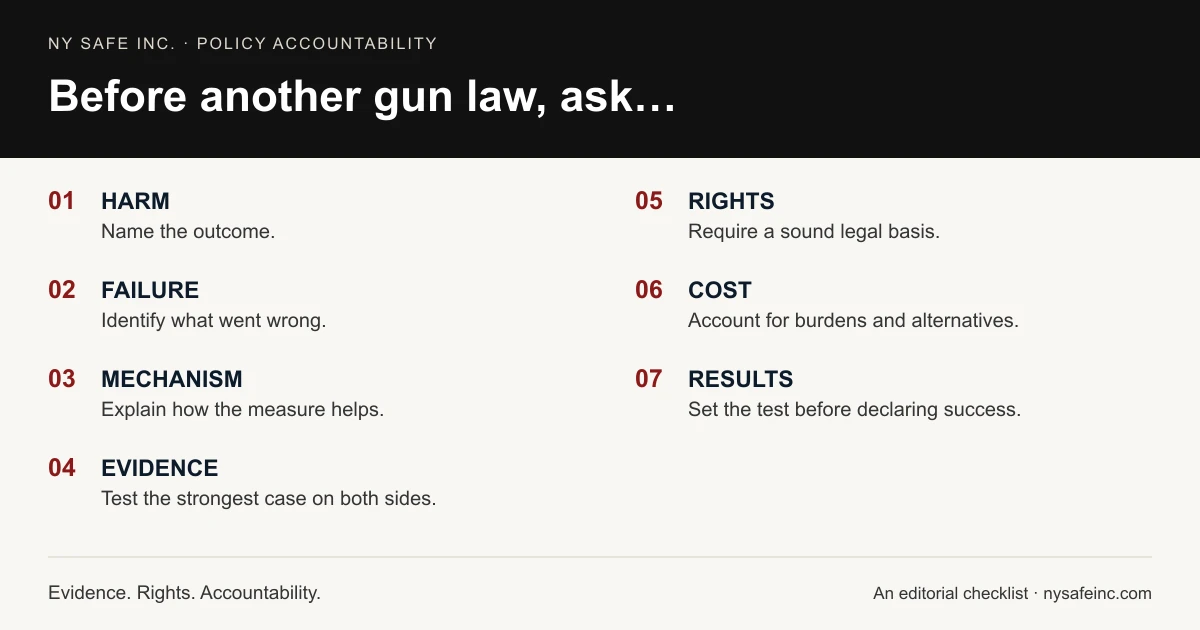
This is an editorial framework for evaluating proposals, not a court’s constitutional test or a prediction model. Use it for a new restriction, a repeal, or an enforcement initiative.
1. What exact harm is the proposal supposed to reduce?
Name the outcome. “Gun violence” can obscure materially different problems. A proposal should specify whether it targets killings, injuries, suicide, unlawful supply, or a particular risk to a threatened community. Success against one outcome should not be advertised as success against all of them.
2. What failed, and how confident are we?
Separate a missing legal power from a failure to use an existing one. Identify whether the explanation is an investigative finding, an allegation, or an unresolved question. Avoid building a permanent policy rationale on an early account that may change.
3. How would this measure change that failure?
Ask for the chain of events: who would do something differently, when, using which authority or information? “It makes access harder” is the start of an explanation. The next question is whose access, through which channel, and with what expected effect.
4. What is the strongest evidence for and against it?
Look for comparable populations, clear definitions, preexisting trends, uncertainty, and other changes occurring at the same time. Demand the same standard from supporters and opponents. A weak study does not become strong because its conclusion is welcome.
5. Does it respect rights and provide fair procedures?
Require the appropriate legal analysis for the jurisdiction. Examine notice, opportunities to contest errors, review of adverse decisions, and the relationship between the restriction and the person or conduct it reaches. Administrative convenience should not end the inquiry.
6. What does it cost, and what receives fewer resources?
Count public spending, staff time, delays, lawful property losses, and compliance costs. Ask whether the same resources could address the identified threat more directly. Compensation may address one financial burden without resolving every concern about a policy.
7. What result would justify keeping, changing, or ending it?
Specify the outcome measure, baseline, comparison, reporting interval, and reviewer before declaring success. Report enforcement activity separately from harm. A policy that cannot be reconsidered when evidence disappoints is being insulated from accountability.
Four claims that need a second question
| When you hear… | Ask… |
|---|---|
| “We recovered more guns.” | What changed in the harm this operation targeted? |
| “Most guns came from elsewhere.” | Which traced subset, and what establishes an unlawful transfer? |
| “The suspect could already have been stopped.” | Which usable authority existed, and what prevented action? |
| “This worked overseas.” | Which measure, outcome, comparison, and constitutional setting? |
The point is not to demand impossible certainty before acting. It is to require an honest explanation of what is known, what is uncertain, and how the policy will be evaluated.
What responsible New Yorkers should take from this
You can defend the right of self-defense and demand serious violence prevention at the same time. Neither position requires accepting unsupported claims from your own side.
When discussing a proposal with an elected official, start with the scorecard. Request the evidence connecting the measure to the harm, the explanation of its legal basis, and the plan for evaluating its effects. Those questions remain useful after the headline changes.
How to use the scorecard in public comment
- Identify the exact bill, regulation, policy, or enforcement practice under discussion.
- Ask officials to state the targeted harm, causal mechanism, supporting evidence, and strongest known limitation.
- Request the legal authority, the affected right, the procedure for correcting errors, and any narrower alternative considered.
- Ask for the baseline, denominator, publication schedule, and date on which results will be reviewed.
- Preserve the response accurately. Quote it in context, link to the underlying record, and correct your own account if later evidence changes it.
For personal decisions, keep policy advocacy separate from compliance. Verify requirements with the relevant licensing authority and qualified counsel when legal exposure is involved. A training provider can help with education and the application process; an attorney should assess a pending charge or individualized legal defense.
Our New York firearm-arrest analysis explores the enforcement debate in more depth. Read its historical data with the distinctions explained here: an arrest is not a conviction, a trace is not proof of trafficking, and a statistical category is not a complete account of conduct.
Frequently asked questions
Does another shooting prove that gun laws failed?
It proves that the existing protections did not prevent that event. Evaluating a policy’s overall effect requires a broader comparison. The event can still expose a particular failure deserving investigation and correction.
Does a decline in gun deaths prove that a specific law worked?
Not by itself. The analysis must address prior trends, other plausible causes, the chosen outcome, and a credible comparison. Evidence about a package of laws may not isolate one provision’s contribution.
Are possession arrests the same as violent acts?
No. An offense’s legal classification and the conduct established in an individual case are different questions. A possession charge alone establishes neither that violence occurred nor that the person presented no danger.
Should officials enforce existing laws instead of passing new ones?
They should first identify what the existing law permits and where implementation failed. Sometimes the proposed repair may require legislation; sometimes it may require better administration or resources. The explanation should identify which problem is being solved.
The standard should be protection that can withstand scrutiny
The right response to tragedy is serious work: establish the facts, protect people facing credible threats, explain the proposed intervention, and account for its consequences.
For lawful gun owners, that means insisting on a defensible connection between the burden imposed and the benefit promised. For public officials, it means accepting that a good intention is not the end of the argument. For advocates, including us, it means acknowledging evidence that complicates a preferred conclusion.
Government should be accountable for the protection it delivers and the rights it burdens.
That is a stronger standard than measuring resolve by how quickly another law can be announced. It is also a standard worth applying when the next proposal comes from someone we support.
Sources and how this article was checked
This analysis distinguishes legislation, interim findings, judicial holdings, research results, reported arrest data, and NY Safe’s policy judgments. Sources are linked at the claims they support. The seven-question scorecard is original NY Safe editorial analysis.
The ATF percentage is a calculation from the identified-source subset, not an estimate for all New York crime guns. The NYC arrest figures are attributed to the published investigation; the underlying individual records were not independently reanalyzed. The Australian studies are selected evidence relevant to the argument, not an exhaustive systematic review. U.S. case summaries are limited to the holdings discussed, not a survey of every pending Second Amendment case.
Australian parliamentary status was checked against the Parliament’s indexed listings on September 8, 2026; direct retrieval of those bill pages was blocked. Recheck the live record before publication or reliance. The Royal Commission remains an ongoing inquiry. NY Safe will revisit this page when further Commission findings or legislative action change the record and will update the substantive-review date when that recheck occurs.
Training and licensing guidance
If your next question concerns your own training or application process, schedule a free 30-minute NY Safe consultation. We can help you understand training and application steps for your jurisdiction. Individual legal disputes and defense advice belong with qualified counsel.
About the author: Peter Ticali leads NY Safe Inc.’s firearms-training and Second Amendment education work.
NRA Endowment Life Member · NRA & USCCA Certified Instructor · Licensed Firearms Instructor: NY, MD, DC, MA, UT · NY Pistol License Holder Since 1992.

No responses yet