
NY Safe Inc. 2026 Public-Safety Evidence Review
Is New York Safer Than Ever in 2026? Crime, Policing, and the Preparedness Gap
Record-low shootings and murders deserve recognition. So do flat felony-assault numbers, uneven transit trends, delayed help, policy tradeoffs, and the duty of ordinary people to prepare without becoming vigilantes.
By Peter Ticali · Last substantively reviewed August 18, 2026 · New York data and law
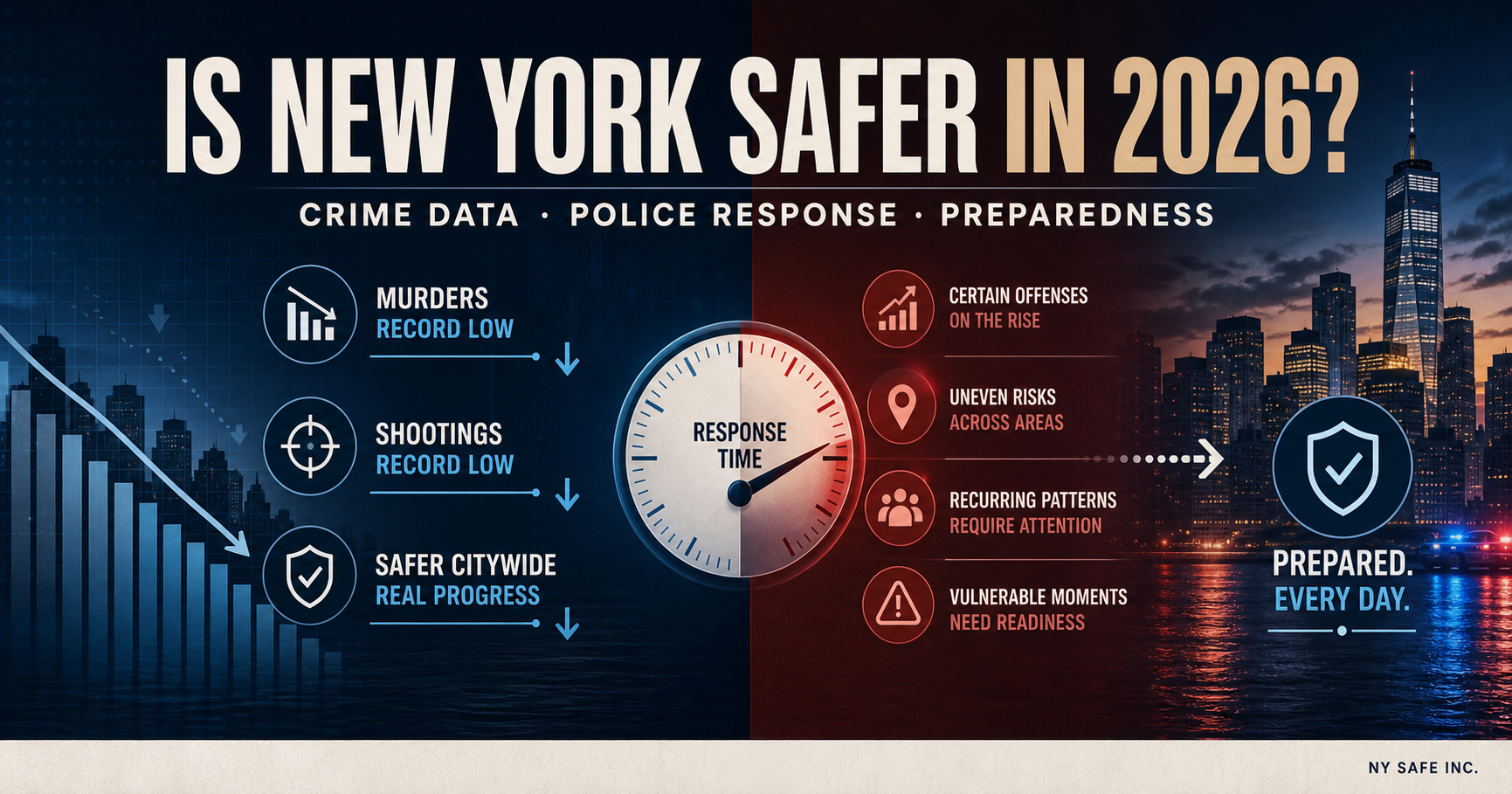
The bottom line: New York is safer by several major measures—but “safer” is not the same as “safe everywhere”
Through July 2026, New York City recorded its fewest murders, shooting incidents, and shooting victims for the first seven months of any year in the NYPD’s recorded history. Major crime fell 6.6%. Those are real gains. Yet felony assault was almost flat, reported rape rose under a broadened definition and with more delayed reports, transit crime rose slightly, and the Preliminary Fiscal 2026 Mayor’s Management Report—covering July through October 2025—reported a 9-minute-54-second end-to-end average for critical crimes in progress, measured from completion of dialing 911 to officer arrival. The responsible conclusion is confidence without complacency: support effective policing, demand honest policy evaluation, and build a layered personal-safety plan centered on awareness, avoidance, communication, first aid, secure storage, and lawful last-resort defense.
Begin with agreement
What “safer than ever” actually means
When officials say New York City is experiencing historic public-safety gains, they are not inventing the central evidence. The NYPD’s August 3, 2026 release reports record-low murders, shooting incidents, and shooting victims for the first seven months of the year. Any honest analysis should celebrate fewer dead and wounded New Yorkers. The NYPD launched CompStat in 1994; this article uses “recorded history” as the department’s term for its modern statistical series, not as a claim that every pre-1994 count is directly comparable without methodology caveats.
The problem begins when a precise claim becomes a universal slogan. “Record-low murders for this seven-month period in the NYPD’s recorded history” is measurable. “Every New Yorker is safer than ever” is not. A citywide total cannot tell a particular person the risk on a particular block, during a particular hour, or inside a particular relationship. It cannot erase nonfatal assault, harassment, disorder, unreported victimization, repeated exposure in a high-risk location, or the minutes before help arrives.
The right comparison is not “statistics or lived experience.” Both matter, but they answer different questions. Statistics estimate broad patterns. Lived experience identifies conditions, locations, and harms that a citywide average can obscure. Neither should be used to cancel the other.
The strongest current evidence
New York City crime in 2026: record lows and warning lights in the same report
The following figures compare January through July 2026 with the same seven months of 2025. They are preliminary NYPD counts, not final audited totals. Percentage changes below are the department’s published calculations.
| Indicator | 2026 | 2025 | Change | What it shows |
|---|---|---|---|---|
| Murder | 149 | 193 | −22.8% | Record low for the period. |
| Shooting incidents | 381 | 412 | −7.5% | Record low for the period. |
| Shooting victims | 462 | 489 | −5.5% | Record low for the period. |
| All seven major crimes | 65,343 | 69,951 | −6.6% | Broad decline across the index. |
| Robbery | 7,643 | 8,699 | −12.1% | Meaningful violent/property decline. |
| Burglary | 6,329 | 7,448 | −15.0% | Large decline. |
| Felony assault | 17,405 | 17,474 | −0.4% | Essentially flat despite the larger decline in major crime. |
| Reported rape | 1,249 | 1,206 | +3.6% | Affected by prior-year reports and the broader definition effective in September 2024. |
| Transit major crime | 1,279 | 1,265 | +1.1% | Slight year-to-date rise; July alone rose 10.9%. |
Source and denominator note: NYPD press release dated August 3, 2026. Counts cover reported incidents in New York City during the first seven months of each year. They are not rates per resident or per trip, and current-year figures are preliminary.
The rape number requires care—not minimization
The NYPD reported that 28% of rapes reported in 2026 concerned conduct from prior years and 20% fell under the expanded definition created by the Rape is Rape Act, effective in September 2024. Those facts make simple year-to-year comparison difficult. They do not make the reports less serious. Better legal coverage and greater willingness to report can increase the measured count while improving recognition of victimization.
Public housing shows why one-month headlines can mislead
Public housing recorded its safest first seven months in the NYPD series for murders, shootings, shooting victims, and robberies. Yet public-housing major crime rose 3.5% in July. Both statements can be true because one describes seven months and the other one month. Honest public-safety writing always names the time window.
New York is more than New York City
Albany and the 28 GIVE departments: lower long-term violence, uneven local movement
New York State’s Gun Involved Violence Elimination initiative tracks shootings involving injury in 28 participating police departments outside New York City. The July 2026 monthly report, with data through June, shows strong regional declines: 197 shooting incidents involving injury compared with 244 during the same months of 2025, a 19% reduction; 223 victims compared with 279, a 20% reduction; and 26 people killed compared with 50, a 48% reduction.
Measurement boundary: GIVE counts shooting incidents involving injury outside New York City; NYPD reports its own New York City shooting-incident series. The two systems are kept separate here, and their rates should not be compared directly.
Albany shooting incidents with injury, January–June
14
Injury-shooting incidents in 2026
13 in 2025; five-year average 26.
14
Shooting victims in 2026
14 in 2025; five-year average 31.
2
People killed in 2026
5 in 2025; five-year average 6.
Albany therefore illustrates the correct level of nuance. The city’s first-half shooting incidents rose by one from 2025, victims were unchanged, and fatalities fell. At the same time, incidents and victims remained roughly half their recent five-year averages. A single percentage without the raw count and longer baseline would distort the picture in either direction.
The City of Albany separately reports that violent crime fell 11% in 2025 and property crime reached its lowest level since 2020, while also acknowledging that its overall crime rate remains above the national average. Long-term statewide context is encouraging: DCJS reports New York’s 2024 index-crime rate was 63% below its 1990 level. That long decline is real; it does not eliminate the need to prepare for low-probability, high-consequence events.
What police statistics do—and do not—capture
Police data count events known to police under defined categories. They are essential, but they are not a census of every harmful experience. The national Bureau of Justice Statistics victimization survey estimated 23.3 violent victimizations per 1,000 people age 12 or older in 2024, while the rate reported to police was 11.2 per 1,000. Those are national survey estimates—not New York counts—and that report does not publish an NYC-only victimization rate. They demonstrate why reported crime and experienced victimization are different measures without supplying a New York City estimate.
Other limits matter:
- Counts are not individual probabilities. A person’s exposure varies by location, routine, occupation, transportation, household, and relationship circumstances.
- Categories change. A broader statutory definition can increase a count without proving that underlying conduct suddenly became more common.
- Small numbers swing sharply. A change of one event can produce a dramatic percentage in a small jurisdiction.
- Crime data do not measure response gaps. An incident may be rare and still unfold faster than a caller can obtain help.
- Recorded crime is not perceived order. Disorder, threatening behavior, and repeated low-level exposure can affect public conduct even when they do not enter the major-crime index.
Viral graphic versus current evidence
Did a decade of laws “tie cops’ hands”? A claim-by-claim fact-check
The phrase is political shorthand, not a measurable variable. Different laws changed different stages of the system: police encounters, arrest processing, pretrial release, evidence disclosure, case readiness, and dismissal. Treating all of them as one policy—or every dismissal as a crime caused—is analytically weak.
| Claim | Verdict | Why |
|---|---|---|
| “Bail reform caused the crime increase.” | Not established | Official tables show rearrests, but rearrest is not causation. Stronger matched research found reductions or neutral effects in major comparisons. |
| “Discovery reform caused serious cases to disappear.” | Partly true, often overstated | NYC misdemeanor speedy-trial dismissals rose sharply; serious indicted-felony dismissals stayed below 1%. Regional variation and 2025 amendments matter. |
| “How Many Stops creates no burden.” | Unsupported | Documenting millions of interactions necessarily requires time and systems. The size and operational effect need continuing measurement. |
| “How Many Stops is pointless paperwork.” | Unsupported | The first-year data revealed 2.7 million encounters and large racial disparities that prior Level 3 reporting did not show. |
| “These policies explain all current police-response times.” | Not demonstrated | Staffing, call volume, dispatch, travel, major events, geography, supervision, reporting requirements, and deployment can all contribute. |
The more defensible argument is narrower: some reforms created real workload and case-processing costs; some produced due-process and transparency benefits; some early claims relied on incomplete data; and policymakers should measure whether the combined system can protect rights, prepare cases, supervise higher-risk defendants, respond promptly, and sustain public trust.
Bail reform: rearrest is real, but the causal claim is harder
New York’s official 2019–2024 pretrial tables show that among 115,409 New York City Criminal Court releases in 2024, 25% had any rearrest within 180 days, 4% had a violent-felony rearrest, 11% a nonviolent-felony rearrest, and 9% a misdemeanor rearrest. Those figures should not be minimized.
They also should not be mislabeled. A rearrest is an allegation following a new arrest, not a conviction. The table does not tell us that bail reform caused the alleged conduct, that detention would have lawfully prevented it, or that populations released in different years had the same risk profiles. It also combines release outcomes with very different baseline risks.
A 2025 Data Collaborative for Justice quasi-experimental evaluation used matched comparison groups over 50 months. For cases made ineligible for bail in New York City, the reform group had lower overall rearrest (57% versus 66%), felony rearrest (33% versus 40%), and violent-felony rearrest (20% versus 25%). Effects in suburban and upstate regions were neutral. Reduced use of bail in eligible NYC cases was associated with modest reductions in overall and felony rearrest and no change in violent-felony rearrest.
This does not prove every aspect of bail reform works perfectly. The same research program has found that effects can vary in smaller, higher-risk subgroups. It does show why a viral before-and-after percentage cannot carry the weight of a causal conclusion.
Discovery reform: the strongest “system strain” evidence—but not the whole story
Discovery reform required prosecutors to disclose evidence earlier and more comprehensively. The due-process case is powerful: a person should not have to consider a plea without timely access to the evidence. Defense providers reported earlier, fuller information and better-informed case discussions.
The implementation problem is also well documented. Drawing on the state court dashboard, the CUNY Institute for State & Local Governance reported that speedy-trial dismissals of NYC misdemeanor arraignments rose from 9% in 2019 to 48% in 2024. The dashboard category is speedy-trial dismissal; it does not independently code every dismissal as caused by a particular missing discovery item. The researchers interpret the trend alongside documented discovery-compliance failures, but the 48% includes all speedy-trial dismissals. The comparable change was 1% to 5% in downstate suburbs and 2% to 4% upstate, with the upstate movement disappearing when two outlier counties were excluded. For the most serious indicted felonies—not felony cases still in Criminal Court—speedy-trial dismissals stayed below 1% in every year and region.
That pattern matters because it rejects two easy narratives. It is not credible to say discovery caused no serious operational problem in New York City. It is also not credible to imply that half of violent felony prosecutions were dismissed. The sharpest effect was concentrated in city misdemeanors, while prosecutors, police, defenders, courts, and technology systems faced different conditions across the state.
The legal baseline also changed. Amendments announced by the Governor took effect on August 7, 2025, altering compliance and dismissal procedures while retaining the early-disclosure framework. A graphic that ends with 2024 data is useful history, not a complete statement of 2026 law or results. The New York Courts discovery dashboard and annual reports should be the update point.
How Many Stops: capacity cost and accountability benefit can coexist
The How Many Stops Act requires NYPD reporting on Level 1, Level 2, and Level 3 investigative encounters. The NYPD now publishes quarterly encounter files, including first-quarter 2026 data.
The Thurgood Marshall Institute’s first-year research brief, analyzing NYPD files from July 2024 through June 2025, found 2.7 million reported encounters—more than 7,000 per day. Nearly 98% were Level 1 encounters, which do not require suspicion of criminal activity. The study reported major racial disparities and explained that prior public reporting of Level 3 stops showed only a small fraction of police-civilian contacts.
Police leadership has described substantial reporting and overtime demands. Those claims deserve an independent, apples-to-apples operational audit: time per report, duplication with existing records, officer and supervisor hours, technology cost, error rates, effect on patrol availability, and whether forms can be simplified without destroying the information’s value.
The wrong choice is between blind bureaucracy and invisible policing. The better objective is minimum necessary reporting that yields auditable public value. If a field never informs supervision, legality review, resource allocation, or public understanding, remove it. If the data expose disparities or unlawful patterns, preserve and improve it. Accountability should be designed as an operational system, not merely added as paperwork.
The strongest opposing case
What criminal-justice reform and gun-violence-prevention advocates get right
A durable preparedness argument must survive the strongest objections, not the weakest caricatures.
Objection 1: Falling violence undercuts the claim that reforms disabled public safety
What it gets right: Record-low shootings and murders are inconsistent with a simple claim that the system has become incapable of controlling violence. Bail research does not establish the sweeping causal harm often asserted.
Our response: Outcome improvement does not prove every process is efficient. Discovery dismissals, response times, repeat offending, and officer workload still deserve measurement. The remedy is targeted repair grounded in evidence—not erasing due process.
Objection 2: “Prepare yourself” can become armed suspicion
What it gets right: Fear-based messaging can encourage racial profiling, needless confrontation, weapon handling under ambiguity, and a fantasy of private law enforcement.
Our response: That is exactly why the preparedness ladder begins with information, avoidance, barriers, communication, and first aid. A firearm creates no authority to patrol, challenge, chase, detain, investigate, or punish. Good preparation should reduce confrontation.
Objection 3: Bringing a firearm into a household can create risk
What it gets right: Unauthorized access, suicide, theft, domestic violence, and mistaken identification are not side issues. A firearm can magnify a moment of despair, anger, curiosity, or confusion.
Our response: A gun is not appropriate for every person or household. Safe storage, crisis planning, honest self-assessment, and lawful temporary separation from firearms when risk rises are core responsibilities. Public-health advocates are correct that home defense and secure storage need not be mutually exclusive; quick-access lockboxes can restrict unauthorized access while preserving a lawful adult’s access.
Objection 4: More armed civilians can complicate police response
What it gets right: Responding officers may not know who is lawful, who fired, or whether a threat remains. Visible weapons, crossfire, poor target identification, and delayed compliance can kill innocent people.
Our response: Civilian defense is a last-resort response to an imminent threat, not a pursuit mission. When the threat ends, force must end. The firearm should be secured or placed down when safely possible before police contact; hands should be visible; commands should be followed; and detailed statements should wait until medical needs and legal counsel are addressed. Exact conduct depends on the scene.
The gap nobody can legislate away
Police can be effective and still be minutes away
The latest Preliminary Fiscal 2026 Mayor’s Management Report measures end-to-end response from the completion of dialing 911 to officer arrival. During July through October 2025—the first four months of fiscal 2026—the average was 9:54 for critical crimes in progress, 13:14 for serious crimes, 15:54 for all crimes in progress, and 32:14 for noncritical crimes (NYPD discussion and table, pp. 15 and 17). These are preliminary fiscal-period averages, not guarantees for any call and not calendar-2026 year-to-date figures.
9:54
Critical crimes
FY26 four-month average
13:14
Serious crimes
FY26 four-month average
15:54
All crimes in progress
FY26 four-month average
32:14
Noncritical crimes
FY26 four-month average
Measure definition: “End-to-end” includes call-processing time from completion of the 911 dial, dispatch, and travel through officer arrival. It is broader than the report’s dispatch-and-travel-only measure, which was 7:32 for critical crimes over the same period.
These averages are not an indictment of police. Officers cannot arrive before a call is made, and dispatchers cannot eliminate distance, traffic, simultaneous emergencies, scene uncertainty, or finite staffing. The federal Cybersecurity and Infrastructure Security Agency makes the same practical point in its active-shooter preparedness guidance: such incidents often end within 10 to 15 minutes, sometimes before law enforcement arrives.
That interval is the preparedness gap. Most people will never need force during it. Many will benefit from a locked door, an exit route, a charged phone, a clear address, a family code word, bleeding-control skills, or the discipline not to enter an avoidable conflict.
Original NY Safe framework
The Preparedness Ladder: eight layers before last-resort force
The ladder is ordered by how broadly useful each layer is. It is not a legal test and does not require a person to complete each rung during an unfolding emergency. Its purpose is to build safety before stress collapses time and choices.
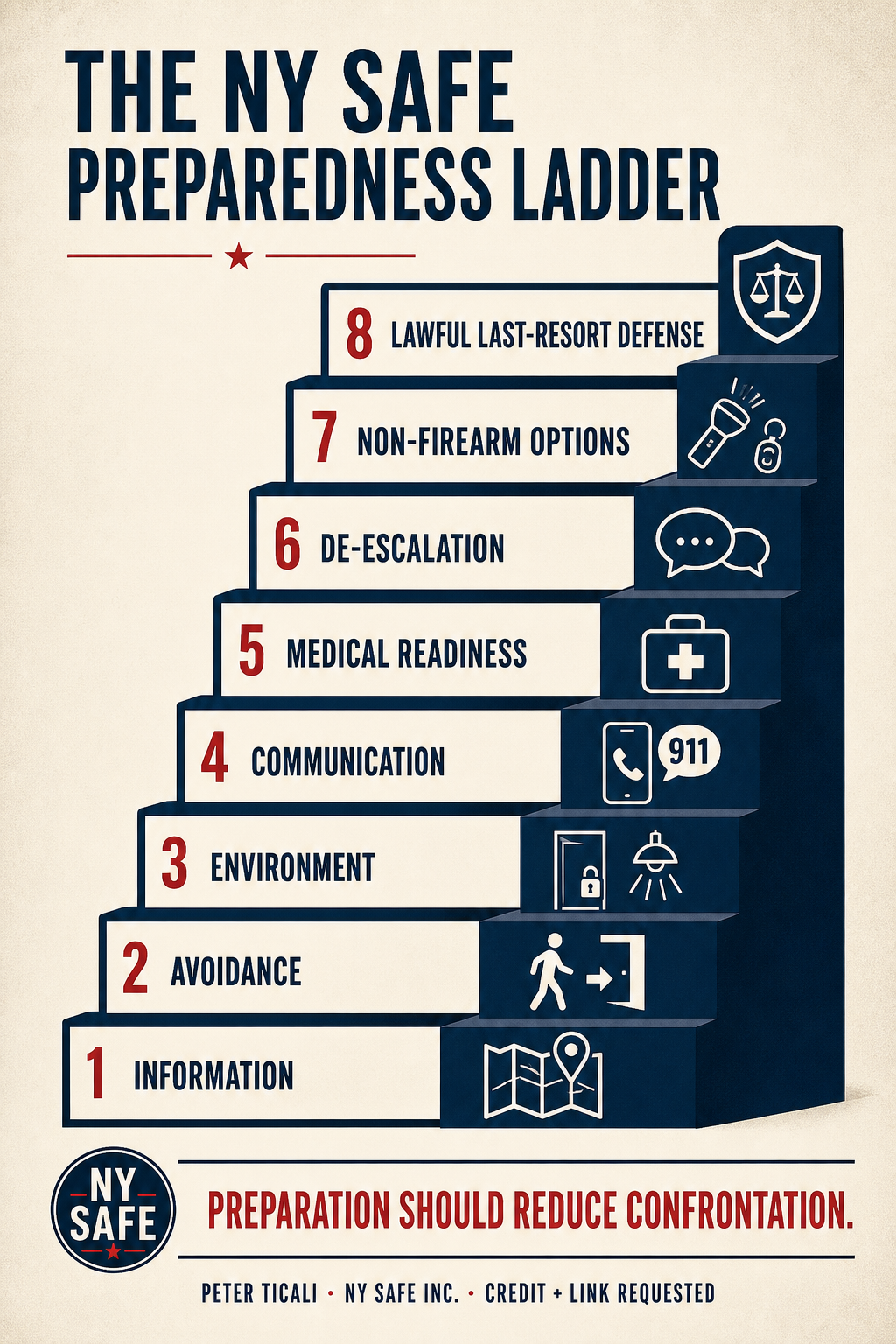
Layer 1 · Information
Know the actual pattern
Use current local reports, building alerts, transit information, and verified warnings. Do not turn a viral video or a stranger’s appearance into a threat assessment.
Layer 2 · Avoidance
Leave early, not dramatically
Change route, create distance, decline arguments, move toward light and people, and trust specific behavior-based warning signs without profiling a category of person.
Layer 3 · Environment
Use locks, lighting, barriers, and exits
Reinforce doors, trim concealment, test alarms, identify two exits, keep vehicle doors locked, and choose a family rally point. Prevention works while nobody is afraid.
Layer 4 · Communication
Call early and communicate clearly
Know your location, describe conduct rather than conclusions, identify clothing and direction, say whether weapons are seen, and follow dispatcher instructions. Teach children how and when to call 911.
Layer 5 · Medical readiness
Prepare to keep someone alive
Learn CPR and bleeding control, maintain an accessible trauma kit, and know medical conditions in the household. The most valuable act after violence may be care, not confrontation.
Layer 6 · De-escalation
Protect the mission from ego
Use calm words, nonthreatening posture, distance, and clear withdrawal. Do not teach strangers lessons. Do not turn property, pride, or disrespect into a life-or-death event.
Layer 7 · Non-firearm options
Match lawful tools to ability and context
Consider alarms, flashlights, communication tools, and lawful defensive options after checking current state and local restrictions. Equipment without judgment can create false confidence.
Layer 8 · Last-resort defense
Force only within law, necessity, and identification
A firearm is not the plan and carrying is not mandatory. Any defensive force must be grounded in the facts, proportional to the threat, directed only at an identified imminent danger, and stopped when necessity ends. New York’s retreat, initial-aggressor, and reasonableness rules matter.
The anti-vigilante line
Why Bernie Goetz is a warning, not a model
The 1984 New York City subway shooting is often reduced to a cultural symbol. The more useful lesson comes from the controlling legal decision. In People v. Goetz, 68 N.Y.2d 96 (1986), the Court of Appeals held that justification contains both a subjective and objective component. The person must actually hold the claimed belief, and that belief must be reasonable in light of the circumstances. Fear by itself does not supply unlimited authority.
Current Penal Law § 35.15 generally permits physical force when and to the extent a person reasonably believes it necessary against the use or imminent use of unlawful physical force. It limits justification for provocation, initial aggression, and combat by agreement. Deadly physical force has additional requirements, including New York’s duty to retreat when the person knows complete personal safety is available, subject to statutory exceptions.
Preparedness never authorizes a civilian to:
- patrol for people who “look wrong”;
- challenge, follow, chase, search, or detain a stranger;
- display a firearm to win an argument or gain compliance;
- use deadly force for property alone, punishment, revenge, or a past threat;
- fire at an unidentified person, uncertain movement, or generalized fear;
- continue force after the imminent necessity has ended.
If a firearm is part of the plan, storage and suitability come first
A person who is unwilling to secure a firearm, train, manage anger, avoid alcohol or impairment while armed, or step away during a mental-health crisis is not prepared merely because that person owns equipment. The decision not to own or carry a gun can be responsible. So can temporarily not carrying when stress, medication, sleep loss, grief, relationship conflict, or impaired judgment changes the risk.
New York Penal Law § 265.45 requires qualifying safe storage where a person under 18 or a prohibited person resides. It also requires an unattended firearm in a vehicle to be unloaded, locked in an appropriate safe-storage depository, and out of sight; a glove box does not qualify. Local rules may be more restrictive.
The Johns Hopkins Center for Gun Violence Solutions—an organization that advocates stronger gun regulation—makes an important point gun owners should adopt rather than resist: home defense and safe storage are not mutually exclusive. A quality quick-access safe can restrict children, visitors, people in crisis, and thieves while preserving controlled access for an authorized adult. Johns Hopkins also reported in a 2018 national survey of gun owners that respondents whose storage decisions were influenced by home-defense concerns were 30% less likely to store all firearms safely—an association, not proof that the motivation caused the behavior.
If someone in the household is experiencing suicidal thoughts, an acute mental-health crisis, or substance impairment, reduce firearm access immediately and seek professional help. Lawful temporary off-site storage may be appropriate, but New York licensing and transfer rules can affect who may receive a firearm and how; verify the method before moving it.
Review NY Safe Inc.’s New York safe firearm storage guide and adapt the plan to the people who actually enter the home—not the ideal household imagined when the safe was purchased.
Turn concern into capability
A seven-day personal-safety reset
- Day 1—Map: identify two exits from home and work, one family rally point, and the precise address or location information a dispatcher would need.
- Day 2—Harden: test locks, exterior lighting, cameras, alarms, intercoms, and visibility around doors and vehicles.
- Day 3—Communicate: choose a family code word, update emergency contacts, charge backup batteries, and teach age-appropriate 911 use.
- Day 4—Learn care: enroll in CPR and bleeding-control training; inspect first-aid and trauma supplies.
- Day 5—Rehearse restraint: practice simple exit language—“I don’t want a problem,” “I’m leaving,” “Call 911”—without insults, threats, or competing for the last word.
- Day 6—Audit tools: check batteries, access, legality, storage, and whether every person who might encounter a defensive tool knows the rules.
- Day 7—Stress-test the plan: ask what happens if the phone is dead, one exit is blocked, a child is in another room, a visitor accesses storage, or police arrive while facts remain unclear.
Preparedness should make daily life calmer. If a plan makes you scan every stranger as an enemy, seek confrontation, or imagine yourself as law enforcement, the plan is failing.
Frequently asked questions about New York crime and preparedness in 2026
Is New York City really the safest it has ever been in 2026?
For specific measures and the specific January–July period, yes: the NYPD reported record-low murders, shooting incidents, and shooting victims in its recorded history. That does not establish a record low for every crime, neighborhood, environment, or personal risk. Felony assault was nearly flat, transit major crime rose slightly, and reported rape rose with important definition and prior-year-report caveats.
Is crime down across New York State in 2026?
The 28 GIVE departments outside NYC reported substantial first-half reductions in shooting incidents, victims, and fatalities. Local movement varies. Albany had 14 shooting incidents through June versus 13 in 2025, although that remained well below its five-year average of 26. Always identify the jurisdiction, offense, period, raw count, and comparison baseline.
Did New York bail reform cause more crime?
The broad causal claim is not supported by the strongest cited evidence. Official data show rearrests among released people, but those descriptive tables do not prove why the alleged conduct occurred. A 2025 quasi-experimental evaluation found lower recidivism in several New York City reform comparisons and neutral effects in suburban and upstate regions. Effects can vary by subgroup, and a rearrest is not a conviction.
Are discovery-reform dismissals a real problem?
Yes, especially for New York City misdemeanors. CUNY ISLG’s analysis of official court data reports that speedy-trial dismissals rose from 9% in 2019 to 48% in 2024. The most serious indicted felonies remained below 1%, regional patterns differed, and statutory amendments took effect in August 2025. The issue is real but narrower and more current-law-dependent than many graphics suggest.
Did the How Many Stops Act take officers off patrol?
The law imposes a real reporting task, but a precise causal claim about patrol availability requires an operational audit of hours, staffing, duplication, supervision, technology, and deployment. The reporting also produced public value: first-year data documented 2.7 million encounters, almost 98% at Level 1, and allowed analysis of disparities that prior Level 3 reporting could not reveal.
How long does NYPD take to respond to an emergency?
The Preliminary Fiscal 2026 Mayor’s Management Report lists an average end-to-end response of 9 minutes 54 seconds for critical crimes in progress during the first four months of the fiscal year. Serious crimes averaged 13:14 and all crimes in progress 15:54. These are citywide averages from completion of dialing 911 to officer arrival—not promises for a particular call.
Does being prepared mean carrying a gun?
No. The most broadly useful preparation is awareness, avoidance, strong doors and lighting, exits, early communication, de-escalation, first aid, and a family plan. A firearm is one last-resort option for a suitable, lawful, trained adult. It can add risk, is not right for everyone, and must never create a vigilante role.
Does New York require retreat before deadly force?
Under Penal Law § 35.15(2)(a), a person facing another’s use or imminent use of deadly physical force generally may not use deadly physical force if the person knows the necessity can be avoided by retreating with complete personal safety to oneself and others. Statutory exceptions apply, including when the person is in their dwelling and was not the initial aggressor. Other enumerated offenses have separate provisions. Facts control.
What does People v. Goetz teach about self-defense?
It teaches that a claimed defensive belief is not judged by subjective fear alone. The person must actually hold the relevant belief, and it must be reasonable in light of the circumstances. The case is a warning against turning generalized fear, anger, or suspicion into armed action.
Are the 2026 crime figures final?
No. NYPD and DCJS identify current-year data as preliminary and subject to revision. This article states the review date, period, and source so readers can distinguish a dated snapshot from a final annual total.
Continue with the question you actually need answered
Further reading: law, response time, judgment, and storage
Can I trust my judgment under pressure?
Use seven decision tests before making concealed carry part of daily life.
What do response times mean for self-defense?
See the dedicated analysis of NYPD response measures and civilian safety planning.
How can an argument destroy self-defense?
Understand provocation, withdrawal, de-escalation, and New York’s initial-aggressor rule.
How should I secure a firearm in New York?
Review household and vehicle storage rules plus practical access-control options.
Can a defender still face a civil lawsuit?
Understand the difference between a demand, a filed claim, liability, and an actual judgment after defensive force.
Methodology and primary source library
Method: NY Safe Inc. reviewed the latest available official crime, court, response-time, and statutory sources as of August 18, 2026. We preserved each source’s time period and denominator, treated current-year data as preliminary, separated arrests from convictions, and used causal language only where a research design attempted causal inference. We included contrary evidence from criminal-justice-reform and gun-violence-prevention sources. GIVE injury shootings and NYPD shooting incidents are treated as separate reporting systems and are not combined or directly rate-compared. No attempt was made to combine incompatible police counts and national victimization-survey estimates into one New York City risk rate.
- NYPD — first seven months of 2026 crime release
- NYPD — current citywide crime statistics
- NYPD — CompStat history and statistical context
- NY DCJS — July 2026 GIVE monthly shooting report
- NY DCJS — New York criminal-justice footprint
- NYC Mayor’s Office — Preliminary Fiscal 2026 Mayor’s Management Report
- Bureau of Justice Statistics — Criminal Victimization, 2024
- NY DCJS — Supplemental Pretrial Release Summary Tables, 2019–2024
- Data Collaborative for Justice — long-term bail-reform evaluation
- New York Courts — discovery dashboard and annual reports
- CUNY ISLG — discovery implementation and dismissal analysis
- New York Governor — 2025 discovery amendments taking effect
- NYPD — investigative-encounter data
- Thurgood Marshall Institute — first-year How Many Stops analysis
- New York Penal Law § 35.15 — justification
- People v. Goetz, 68 N.Y.2d 96 (1986)
- New York Penal Law § 265.45 — safe storage
- CISA — active-shooter preparedness
- Johns Hopkins — safe storage and home-defense compatibility
- Johns Hopkins — national gun-owner storage survey
Start with judgment before deciding whether a firearm belongs in your plan
NY Safe Inc.’s personal-protection webinar addresses New York law, realistic risk, avoidance, alternatives, and the responsibilities of firearm ownership without assuming that every attendee should carry. For the deeper decision standard, read New York Concealed Carry: 7 Critical Judgment Tests.
Learn the risks, legal limits, and non-firearm options before making the carry decision.
Next Available Classes
Upcoming Personal Protection Webinar Dates
Live online. Register from anywhere.

For journalists, researchers, and educators
Quote, verify, challenge, and link to the exact section
Brief quotations from this article and the NY Safe Preparedness Ladder may be reused with attribution to Peter Ticali, founder and lead instructor of NY Safe Inc., and a link to the published article. Please preserve the article’s central qualification: falling citywide crime and continuing individual preparedness needs can both be true.
Fast source desk
- For the 2026 NYC split-screen data, link to #nyc-data.
- For the reform claim audit, link to #policy-fact-check.
- For response-time context, link to #response-gap.
- For the original preparedness framework, link to #ladder.
- For the anti-vigilante and Goetz analysis, link to #goetz.
Interview angles: how to discuss falling crime without dismissing victims; how response-time data should shape family planning; why responsible firearms training begins with avoidance; where reform critiques are supported and overstated; how secure storage fits both public-health and home-defense goals; and how journalists can distinguish rearrest, dismissal, acquittal, and conviction.
Attribution does not imply NY Safe Inc. endorses a publication or its coverage. For substantial republication, graphics licensing, data questions, or an interview, contact NY Safe Inc. through its verified website.

No responses yet